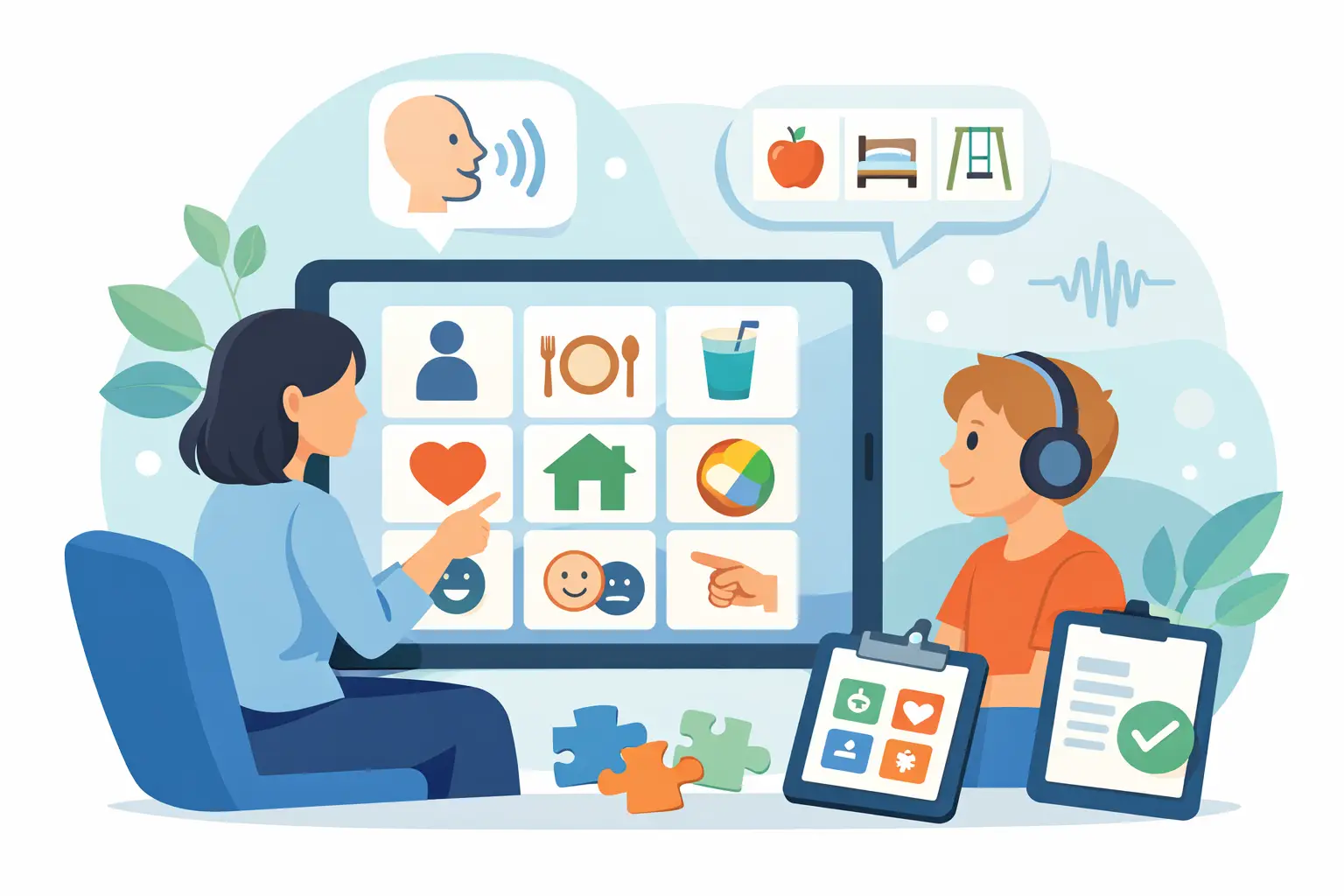
A child may use an AAC system confidently during a therapy session, then struggle to find the same words at home or school. That gap is where an AAC app for speech therapists can make a meaningful difference. The right platform does more than produce speech. It helps clinicians carry goals beyond the clinic, gives families a clear starting point, and shows whether communication support is actually being used in daily life.
For speech-language pathologists, choosing an AAC app is not simply a technology decision. It is a clinical decision that affects assessment, intervention, caregiver coaching, documentation, and the child’s opportunity to communicate throughout the day.
What speech therapists need from an AAC app
AAC should never be limited to requesting snacks or choosing a preferred activity. A communication system needs to support genuine participation: commenting during play, asking questions, protesting, sharing feelings, telling stories, connecting with peers, and repairing communication breakdowns.
That requires an app that is flexible enough for individual communication needs without creating an overwhelming setup burden. Therapists need to be able to shape vocabulary, model language, and adjust access as a child develops. Families, meanwhile, need a system they can understand and begin using without waiting weeks for a specialist appointment.
The strongest platforms make both needs possible. They provide a practical starting point for caregivers while leaving room for professional guidance, individualized vocabulary, and goal-based intervention.
A communication board built for more than requesting
Look for a symbol-based communication board that supports core vocabulary alongside meaningful fringe words. Core words such as “go,” “help,” “more,” “like,” and “not” can be used across many settings and messages. Fringe vocabulary brings the child’s world into the system: favourite people, school activities, places, cultural foods, routines, and interests.
A board should be easy to navigate, visually clear, and capable of growing with the communicator. At the same time, clinicians should be cautious about changing layouts too often. Consistency helps motor learning. A child who is learning where a word lives on the screen benefits when that location remains predictable.
Speech output that supports real interaction
Speech output gives a child a way to be heard by people who may not know their gestures, signs, or approximations. It can increase independence at school, in the community, and with unfamiliar communication partners.
Still, the goal is not to make a child sound a particular way. The goal is to give them access to language and agency. An AAC app should make it easy to build messages, speak them aloud, and return to communication quickly during the messy, fast-moving moments of daily life.
Why shared data changes AAC intervention
Therapy notes are essential, but they are only one view of a child’s communication. A 45-minute session cannot fully show what happens during morning routines, recess, dinner, community outings, or bedtime. Usage data can add valuable context when it is interpreted thoughtfully.
For example, a therapist may see that a child uses their system regularly at home but relies on only a small group of words. That can point to a vocabulary expansion goal, a modelling plan for caregivers, or a need to adjust the board’s organization. If use drops suddenly, the team can ask practical questions: Is the device available? Is it charged? Did a routine change? Does the child need more partner support?
Data is not a scorecard for families. More taps do not automatically equal better communication, and lower use does not mean a caregiver has failed. The value is in finding patterns without guessing, then using those patterns to make support more responsive.
Reports that reduce documentation pressure
For clinicians working across private practice, schools, and multidisciplinary teams, reporting can consume valuable time. An AAC platform with clear progress tracking and weekly reporting can support more focused conversations with families and educators.
Useful reports should be understandable to both clinical and non-clinical partners. They can help document vocabulary exposure, communication opportunities, emerging skills, and goals that need more modelling. In education settings, this information may also support IEP discussions by connecting communication goals to observable use across environments.
No app can replace professional clinical judgement or a comprehensive AAC assessment. But reliable information from home and school can make planning more grounded and reduce the reliance on memory, scattered messages, and incomplete handovers.
Supporting families between sessions
Caregiver confidence is one of the biggest factors in AAC carry-over. Parents often want to help immediately, but may worry about doing it wrong. They may have heard conflicting advice about modelling, prompting, device time, or whether AAC will affect speech development.
A well-designed app can lower that pressure by providing clear, practical coaching. Instead of handing families a device and a long list of instructions, therapists can guide them toward small, realistic actions. Model one or two words during a familiar routine. Keep the device within reach. Respond to every communication attempt. Pause long enough for the child to participate.
The best coaching is specific to real life. A parent does not need a perfect therapy table at home. They need to know how to model “open” while unpacking groceries, “again” during a favourite game, “stop” when a sibling is too close, or “fun” on the playground.
When an app includes built-in coaching informed by actual usage, the support can become more timely. A family may need help with consistency, while another may be ready to expand beyond requesting. Those are different needs, and they should not receive the same generic advice.
How to evaluate an AAC app for speech therapists
A quick demonstration can make almost any app look promising. Before recommending a platform, consider how it will work after the first week, when real routines and real barriers appear.
Start with implementation. Can a parent begin in minutes with a useful communication board? Is the setup manageable for a busy clinician? Can vocabulary be personalized without making the system hard to maintain?
Next, look at collaboration. A child should not have separate communication systems for home, therapy, and school whenever it can be avoided. Ask whether caregivers, therapists, and educators can work from the same information, align language targets, and see relevant progress without exchanging endless screenshots or paper notes.
Then consider reporting and clinical fit. The app should help you see patterns, support measurable goals, and make documentation easier. It should also respect that the therapist remains responsible for interpretation. Data should inform intervention, not dictate it.
Finally, assess the child’s access and autonomy. A feature-rich app is not automatically a better app if the child cannot comfortably see, navigate, hear, or physically access it. Some communicators need larger targets, simplified displays, alternative access methods, or a slower pace of change. AAC selection is always individual.
A connected approach to communication support
Standalone AAC tools can give children a voice, but fragmented systems often leave adults doing the hard work of connection. Parents may be unsure what to model. Therapists may have limited visibility between sessions. School teams may receive goals without enough context to carry them into the day.
A connected platform brings those pieces closer together. VoiceBloom combines a symbol-based communication board and speech output with progress tracking, reporting, therapist collaboration, and caregiver coaching. This approach helps families start without unnecessary delay while giving professionals the information needed to guide communication growth with confidence.
That balance matters. Families deserve immediate access to communication support. Therapists deserve tools that honour clinical expertise rather than add more administrative work. Most importantly, children deserve a system that is available wherever they have something to say.
The right app should make communication easier to carry forward
The best AAC app is not necessarily the one with the most features. It is the one that a child can access, communication partners can model, and the whole team can use consistently. It should make it easier to notice progress, respond to challenges, and create more opportunities for authentic communication throughout the day.
Start with the child’s daily life, not the app’s feature list. When AAC is present at home, supported in therapy, understood at school, and connected to clear goals, communication has more room to grow.