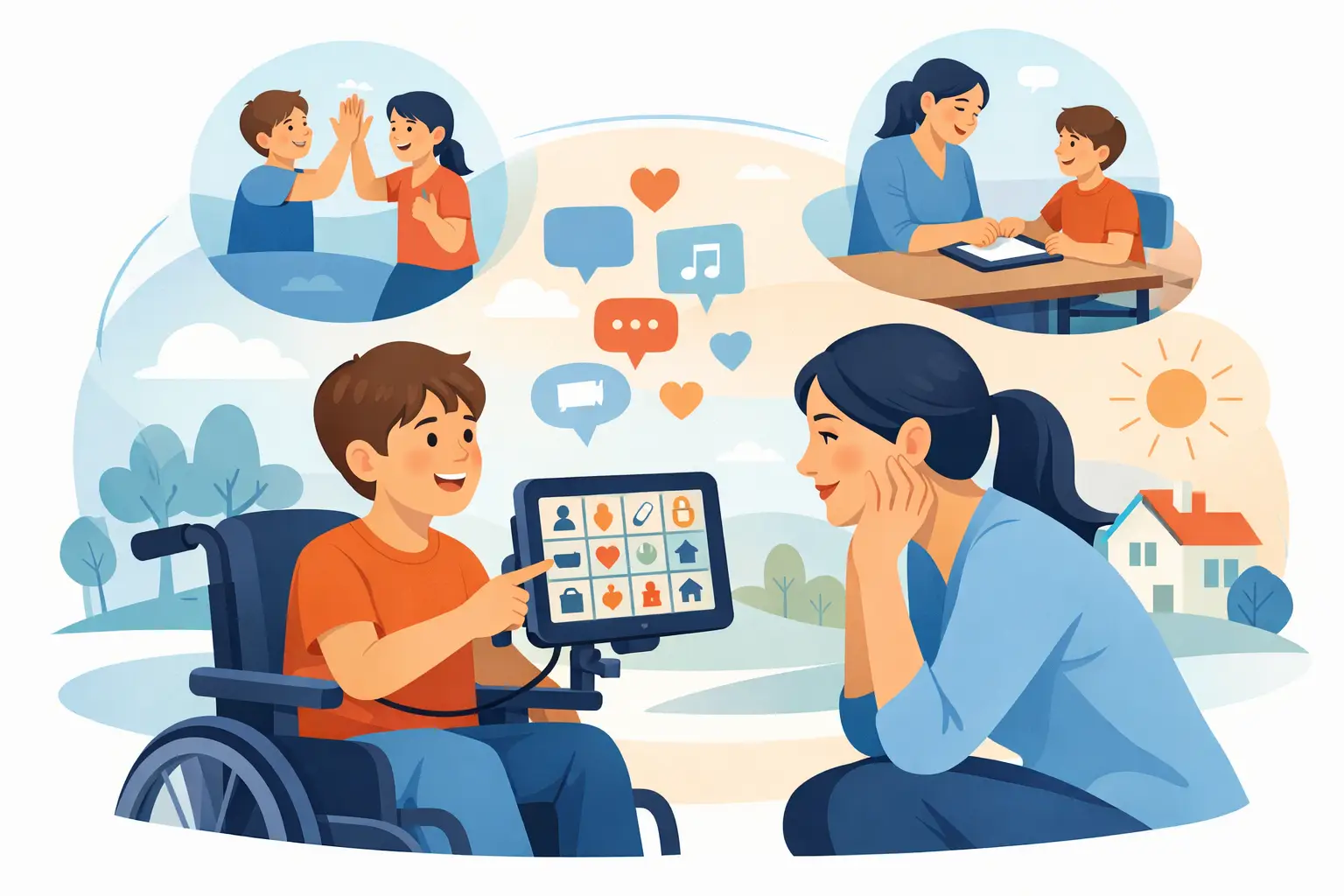
A child who cannot reliably say what they want may still have plenty to say. They may be thinking, choosing, protesting, joking, asking questions, and trying to connect - without a dependable way to make those messages understood. AAC benefits begin with changing that daily reality. It gives children another path to express themselves, while giving the adults around them a clearer way to listen and respond.
AAC, or augmentative and alternative communication, can include picture symbols, communication boards, speech-generating devices, gestures, sign, and written words. It is not a last resort or a sign that a child has “given up” on speech. For many children, it is the support that makes communication possible now, while language and speech skills continue to develop in their own time.
AAC benefits start with access, not perfection
Communication is about more than requesting a snack or choosing a favourite video. Children need ways to say no, tell someone they are hurt, share an idea, ask for help, join a game, and talk about something that happened yesterday. When those options are unavailable, frustration can quickly become the loudest message in the room.
AAC gives a child access to words and messages that match their current abilities. A symbol-based system, for example, can let a child select “more,” “stop,” “I feel sick,” or “play outside” even if spoken words are difficult to produce. Speech output can make that message easier for others to understand, especially beyond the family members who know the child best.
The goal is not perfect use on day one. The goal is meaningful access. A child may begin by exploring buttons, repeating a favourite message, or using one symbol consistently. Those early moments matter because they show the child that communication works: when I make a choice, someone notices and responds.
Less frustration, more agency
One of the most immediate AAC benefits families often notice is a reduction in communication breakdowns. This does not mean every difficult moment disappears. Children still have big feelings, busy days, and needs that are hard to identify. But AAC can provide a practical alternative when pointing, guessing, or repeated questions are not enough.
Agency is the deeper benefit. When a child can say “not that,” “wait,” “different,” or “I want to do it,” they have more control over their day. That control supports dignity. It also helps adults move away from guessing games and toward genuine conversation.
For parents, this can change ordinary routines. Getting dressed, leaving the house, eating dinner, or settling for bed may become less about interpreting distress and more about responding to a clear message. For educators and therapists, it creates more opportunities to understand what a child knows, prefers, and is trying to learn.
AAC can support language and speech development
A common concern is whether AAC will stop a child from talking. AAC does not prevent speech development. In fact, it can support language by giving children a way to connect words with meaning, see or hear language modelled consistently, and practise communicating without the physical pressure of producing speech.
A child does not need to prove they will never speak before receiving AAC. Waiting for certainty can mean waiting through months or years when communication could already be growing. AAC and speech can work together. A child might speak some words, use gestures in familiar settings, and rely on a communication device for longer messages or when they are tired, anxious, or misunderstood.
Progress will look different for every child. Some children use AAC as a bridge while spoken language increases. Others use it as a long-term primary communication method. Neither outcome is a failure. The meaningful question is whether the child has a reliable way to express what they think, feel, and need.
Modelling makes the system more useful
Children learn language by seeing and hearing it used around them. The same principle applies to AAC. Adults can model words on the child’s system while speaking naturally: selecting “go” before heading to the park, “fun” during a game, or “finished” when an activity ends.
This is not a test. Children do not need to copy every selection or respond on demand. Consistent modelling simply shows them where language lives on the system and how it can be used for more than requests. Small, repeated moments are often more effective than saving AAC for therapy time or asking a child to perform.
Participation grows at home, school, and in the community
Communication access affects belonging. A child who can contribute at circle time, answer a question, tell a sibling to stop, or order their own drink is not only practising language. They are participating in relationships and routines that shape childhood.
That participation may require adjustments. A child may need extra wait time, a device within reach, vocabulary prepared for a class activity, or partners who know how to pause and listen. The trade-off is real: adults may need to slow down at first and build new habits. Yet the alternative is often that adults speak for the child because the moment moves too quickly.
AAC works best when it is available throughout the day, not stored away for special occasions. Keeping it close during play, meals, appointments, and outings gives a child more chances to discover that their voice belongs everywhere.
Clearer data leads to more confident support
For families and professionals, communication support can feel fragmented. A parent may see new words at home, an SLP may focus on a specific goal in a session, and a teacher may notice different strengths at school. Without a shared view, important patterns can be missed.
Modern AAC tools can make progress easier to see. Usage patterns may show which words a child uses most, when communication increases, what vocabulary needs to be added, or whether a new routine is creating opportunities for success. This data should never replace professional judgement or a parent’s insight. It can, however, turn vague impressions into useful conversations.
For therapy teams and educators, consistent data can support goal setting, documentation, and IEP-ready reporting. For parents, it can replace some of the uncertainty with evidence: these are the messages my child is using, these are the contexts where they are communicating, and this is where we can offer more support.
VoiceBloom brings communication boards, speech output, progress tracking, coaching, and collaboration into one connected platform, so families can start in minutes while therapists and schools have clearer visibility over time.
Consistency matters more than complicated setup
The best AAC system is not necessarily the one with the most pages, the largest vocabulary, or the longest setup process. It is the one a child can access consistently and that their communication partners are prepared to use.
Start with vocabulary that matters to the child’s real life: people they love, favourite activities, useful actions, feelings, and words that let them direct the interaction. Then expand as their interests and communication opportunities grow. A system should be flexible enough to evolve, rather than forcing a child to fit someone else’s idea of what they should say first.
Families do not need to wait until every symbol is organized perfectly. Begin with a dependable foundation, use it in ordinary moments, and learn from what the child shows you. If a word is used often, make it easier to find. If a child is trying to communicate something not represented, add it. If use drops, consider whether the vocabulary, access method, or adult support needs to change.
The adults around a child are part of the communication system
AAC is most powerful when children do not have to carry the full responsibility for making themselves understood. Parents, siblings, educators, educational assistants, and clinicians all shape whether a communication tool becomes part of life or sits unused.
That shared responsibility does not mean parents must become AAC experts overnight. It means creating a few realistic habits: keep the system available, model without pressure, honour every attempt to communicate, and give the child time to respond. Professionals can help refine goals and access, while families offer the knowledge that makes vocabulary meaningful.
A child deserves more than adults who can predict their basic needs. They deserve the chance to surprise people, disagree, share a joke, and be known. Start with one routine, one message, and one moment of waiting. A growing voice often begins there.