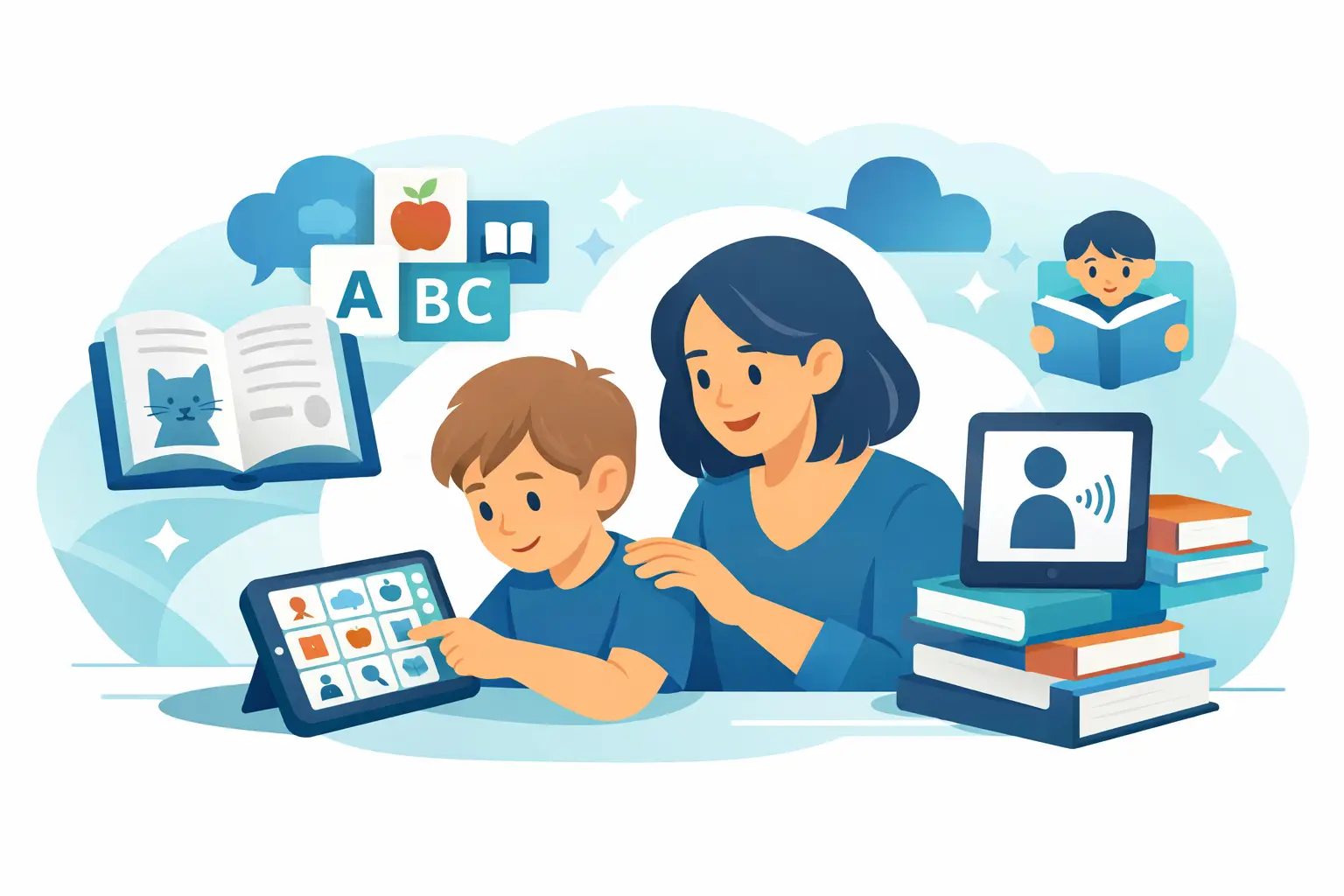
A child who cannot easily speak still has ideas worth sharing, stories to tell, and words to learn. That is why the question, does AAC support literacy, matters so much. For many children with complex communication needs, AAC is not separate from reading and writing. It can be one of the ways they participate in both from the very beginning.
AAC, or augmentative and alternative communication, includes tools such as symbol-based communication boards, speech-generating devices, and communication apps. Used well, these tools give children access to language they can see, hear, choose, repeat, and use with real people. That repeated access can create meaningful opportunities to develop the skills behind literacy.
Does AAC Support Literacy Development?
Yes, AAC can support literacy development, particularly when adults treat the system as a language tool rather than only a way to request snacks, toys, or breaks. Children need access to words for asking, protesting, commenting, joking, describing, asking questions, and telling stories. Those same language experiences support comprehension, vocabulary, sentence building, and early writing.
AAC does not automatically teach a child to read. No single app, device, or set of symbols can replace direct literacy instruction, shared reading, or responsive conversation. But it can remove a major barrier: limited access to expressive language. When a child has a reliable way to participate, adults can better see what they understand and help them build on it.
For children who are non-verbal or minimally verbal, AAC may also reduce the pressure to rely on speech before they can join a literacy activity. A child can select a symbol, hear the word spoken aloud, point to a printed word, choose a character's feeling, or help create a sentence. Each of these moments says, clearly, “I am part of this.”
How AAC Connects Language and Literacy
Literacy begins long before a child reads a book independently. It grows through hearing language, connecting words to meaning, noticing print, playing with sounds, building vocabulary, and learning that messages can be shared in more than one form. AAC can support these foundations in practical, everyday ways.
Symbols can build meaning, not limit it
Some families worry that symbols will keep a child from learning written words. In practice, symbols can act as a bridge. A symbol paired with a spoken word and printed text gives the child multiple ways to access the same idea. For example, seeing a picture of “go,” hearing “go,” and eventually noticing the letters G-O can help make the word more meaningful.
Symbols are especially useful when a child is still learning that words represent people, actions, objects, and experiences. They should not be the final destination for every learner. As children develop, adults can introduce print alongside symbols, add alphabet access, and support spelling in ways that match the child’s motor, visual, language, and learning needs.
AAC creates more chances to practise real language
A literacy worksheet may ask a child to identify a word once. AAC can offer dozens of meaningful chances to use that word throughout the day. During a book, a child might say “again,” “funny,” “sad,” or “I think.” At lunch, they might use “more,” “different,” or “not that.” During play, they can create a plan, explain a problem, or tell someone what happened.
This matters because literacy is connected to language experience. The more a child can engage with words in meaningful contexts, the more material they have for understanding books, writing messages, and expressing their own ideas.
Speech output can strengthen word awareness
When a child selects a word or message and hears it spoken, they receive immediate feedback. They can connect the symbol or written word to its pronunciation and meaning. This can be helpful for children who benefit from repetition, though the goal is not simply to press buttons over and over.
The most valuable learning happens in interaction. A parent or educator can respond to the child’s message, expand it naturally, and model another way to say more. If a child selects “dog,” an adult might say, “Yes, the dog is running. Where do you think he is going?” The child is being invited into language, not tested on it.
What Literacy Support Looks Like at Home and School
The strongest AAC literacy support is consistent, enjoyable, and connected across settings. Children should not have to leave their communication system behind when it is time for a story, a classroom lesson, or a family conversation.
During shared reading, keep the AAC system available and use it yourself. Model simple comments such as “look,” “wow,” “I like it,” “turn page,” “he is sad,” or “what next?” You do not need to model every word in the book. A few meaningful examples show the child that their system belongs in reading time.
Writing can start with authentic messages, not perfect spelling. A child might use AAC to choose what to write in a card, create a caption for a photo, make a shopping list, or retell a favourite event. They may select whole words, choose letters, use word prediction, or combine symbols and text. The right approach depends on the child.
At school, AAC should be part of classroom participation. If classmates are answering a question, the AAC user needs enough time and access to relevant vocabulary to answer too. If the class is writing about a science experiment, the child may need words such as “mix,” “wet,” “cold,” “first,” and “because” available before the activity starts.
This preparation is not giving answers. It is giving access.
Start With Language, Then Build the Literacy Path
Parents often feel they need to choose between helping a child communicate now and preparing them for reading later. That is a false choice. Giving a child a voice now can support the language growth that literacy relies on.
Start by making AAC available throughout the day, not only during structured practice. Model words without demanding imitation. Read books your child enjoys, even if they want the same one every night. Pair spoken words, symbols, and print where it makes sense. Celebrate messages that are imperfect, surprising, funny, or deeply personal.
For some children, early literacy instruction will include alphabet knowledge, sound awareness, and letter selection. For others, it may begin with understanding stories, building vocabulary, recognizing their name, and learning that print carries meaning. Progress will not look identical for every child, especially for children with motor, sensory, visual, or cognitive differences.
The key is to avoid making assumptions. A child who cannot speak does not necessarily have limited understanding. A child who uses symbols is not necessarily unable to learn print. Give access first, observe carefully, and adjust support based on what the child shows you.
Collaboration Makes AAC Literacy Support Stronger
AAC works best when families, educators, and speech-language pathologists share a clear picture of what a child is using and learning. A word practised in therapy should be useful at home. A classroom writing goal should connect to the vocabulary available on the child’s system. Family observations should help shape the next step, not sit in a notebook unseen.
This is where usage data can be genuinely helpful. Knowing which words a child uses often, which pages they visit, and where communication drops off can guide more relevant modelling and literacy activities. A connected platform such as VoiceBloom can help families and professionals see patterns, share progress, and make decisions with less guesswork.
Data should support professional judgment and family knowledge, not replace either. A report can show that a child selected “want” frequently. It cannot, on its own, explain whether the child had enough words available to share an opinion, tell a story, or join a group conversation. The adults around the child still provide the context.
Common Concerns Parents Hear About AAC and Reading
One concern is that AAC will delay speech or distract from literacy instruction. Current clinical practice recognizes AAC as a support for communication, not a barrier to learning language. Children can use AAC while also working on speech, listening, reading, and writing goals. The approach should be individualized, but communication access should not be withheld while adults wait for speech to emerge.
Another concern is that a child must master symbols before being introduced to letters. Some children benefit from a gradual move from symbols to print. Others show interest in letters early and should be given meaningful alphabet access alongside their symbol vocabulary. There is no benefit in waiting for a child to prove readiness through frustration.
A final concern is that literacy work will feel like another demand. It can, if every interaction becomes a test. Keep the focus on connection. Read a silly book. Write a message to a grandparent. Make a menu for a pretend restaurant. Let communication lead the activity whenever possible.
A child’s AAC system is more than a way to get needs met. It can be a place to build sentences, explore words, share a point of view, and take part in the written world. Start with the language your child wants to use today, and let that voice grow into tomorrow’s stories.