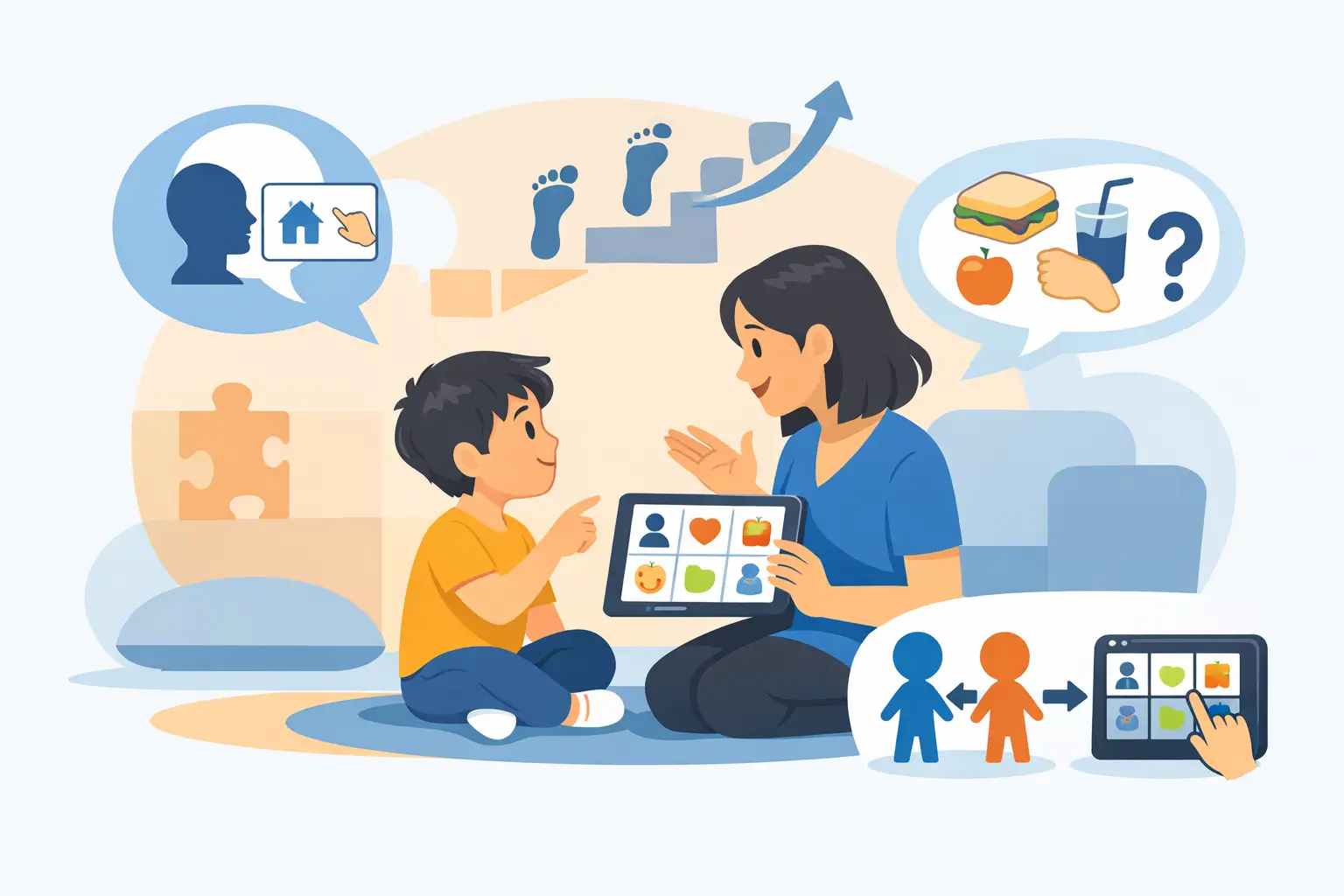
A child who cannot easily say “more,” “stop,” or “help” still has plenty to communicate. The right AAC support makes those messages available in the moments that matter: at breakfast, during play, in class, and when frustration starts to build. This AAC for autism guide is designed to help families move from uncertainty to a practical first step - without waiting for communication to become a crisis.
AAC, or augmentative and alternative communication, is not a last resort. It is a way to give a child reliable access to language while speech develops, changes, or remains difficult. For many autistic children, AAC can reduce pressure, support understanding, and create more opportunities to connect.
What AAC can look like for an autistic child
AAC includes any tool that supports communication beyond spoken words. It can be as simple as pointing to a picture, gesturing, or choosing a printed symbol. It can also be a speech-generating device or app that allows a child to select words and hear them spoken aloud.
For minimally verbal and non-verbal children, a symbol-based communication board is often a useful starting point because it makes language visible. A child may select “want” and “bubbles,” for example, or choose “all done” when an activity feels overwhelming. Over time, the system can grow from a few meaningful words to combinations, comments, questions, and social language.
The best AAC system is not necessarily the one with the most buttons or the most advanced technology. It is the one your child can access comfortably, understand, and use consistently with the people around them. Motor skills, vision, sensory preferences, literacy, language development, and the child’s daily routines all affect what will work best.
AAC for autism: start with communication, not perfection
Many parents worry about getting AAC “right” before introducing it. That concern is understandable, especially when families have been told to wait for an assessment or specialist recommendation. But communication access should not be delayed while adults search for a perfect plan.
A good first setup focuses on words that give your child genuine control. Think about what they already try to tell you through reaching, leading you by the hand, sounds, facial expressions, or behaviour. If they pull you toward the pantry, words such as “eat,” “cracker,” “more,” and “different” may be more useful than a large collection of category labels.
Begin with language that serves several purposes. Requests matter, but AAC should also give children ways to refuse, comment, greet, ask for help, and share how they feel. A system used only to ask for snacks can become frustratingly limited. A child deserves words for “funny,” “again,” “no,” “I don’t like it,” and “look.”
Keep the board available, not stored away for practice time. AAC works best when it is part of life, not a task that appears for ten minutes at the kitchen table. Bring it to the park, keep it nearby during meals, and make sure it travels between home, school, and therapy when possible.
Model the words you want your child to learn
Children learn AAC by seeing other people use it. This is called modelling or aided language input. It does not mean asking your child to copy every selection. It means you point to or select words on the AAC system while you speak naturally.
If you are pouring juice, you might say, “You want more,” while selecting “want” and “more.” During a favourite game, you could select “go,” “again,” or “fun.” When your child looks upset, model “stop,” “help,” or “break.” Keep your spoken language warm and normal. The AAC tool is simply another way to make meaning clear.
Modelling takes pressure off. Instead of testing whether your child knows a word, you show them where that word lives and when it is useful. Repetition matters, but it should happen in real moments rather than through drills alone.
It may feel awkward at first, particularly if you are learning the layout yourself. That is normal. Pick a few high-value words and use them often. Consistency will matter more than speed.
Choose vocabulary that can grow with your child
Some early AAC boards focus heavily on nouns: foods, toys, animals, and favourite activities. Those words are valuable, but they are not enough by themselves. Core words - flexible words such as “more,” “go,” “want,” “not,” “help,” and “like” - can be used across many situations.
A balanced system includes core words alongside personal words that reflect your child’s real life. Their sibling’s name, a favourite character, a preferred snack, or a regular school activity may be highly motivating. The goal is not to fill every space immediately. It is to provide language that feels useful today and can expand tomorrow.
Avoid removing words because your child has not selected them yet. AAC users often need many chances to see and hear language before they begin using it independently. Keep modelling, notice what captures their interest, and make thoughtful additions as routines change.
Make AAC part of home, school, and therapy
Communication progress is easier when adults share the same approach. A child should not have one set of words at home, another at school, and no clear way to carry learning between settings. Even small alignment can reduce confusion and create more chances for success.
Share the key words and routines your family is practising with your child’s educator and speech-language pathologist. Ask which words are being modelled in class or therapy, then use some of those same words at home. In return, tell the team what your child is choosing, avoiding, or trying to communicate during everyday activities.
This is where usage data can be helpful. A record of selected words, communication frequency, and emerging patterns gives adults more than a general impression of how things are going. It can help identify whether a child is communicating most during snacks but not during group activities, or whether they are beginning to combine words in one environment but not another.
VoiceBloom brings the communication board, progress tracking, parent coaching, and professional collaboration into one connected platform, so families can start in minutes while therapists and schools have clearer information to guide next steps.
Watch for progress beyond spoken words
Progress with AAC is not always a straight line, and it is not measured only by how many words a child speaks. A child may first look toward the device, tolerate it nearby, or begin reaching for it. They may use one symbol repeatedly before exploring more language. They may communicate more at home than at school, or become quiet when a device layout changes.
These are not failures. They are useful clues. Look for growing independence, more intentional choices, reduced frustration, greater participation, and new ways of connecting with others. A child who selects “stop” instead of crying has communicated something important. A child who says “again” through AAC has started a conversation.
If communication seems to stall, review the environment before assuming the child is not ready. Is the device within reach? Are adults modelling enough? Are the available words meaningful? Is the child tired, overstimulated, or being asked to communicate under too much pressure? Small changes can make a meaningful difference.
Common AAC concerns, answered clearly
Will AAC stop my child from talking?
Research and clinical experience consistently show that AAC does not prevent speech development. For some children, it can support spoken language by reducing frustration and giving them a clear model for words. The goal is communication in whatever form works for the child, not forcing one pathway.
Do we need to wait for an SLP before starting?
An SLP can provide valuable assessment and individualized guidance, especially for access, language planning, and complex needs. But families do not need to wait to begin offering meaningful communication opportunities. Starting with a simple, accessible system and involving an SLP when available can be a practical path.
What if my child only uses AAC to request things?
Requests are a valid and powerful place to begin. Continue honouring them, then model language for refusing, sharing, commenting, and connecting. Children are more likely to explore new communication when they see it work for their own goals.
Your child does not need to earn access to a voice. Put meaningful words within reach, respond to every attempt, and let communication grow through the ordinary moments you already share.