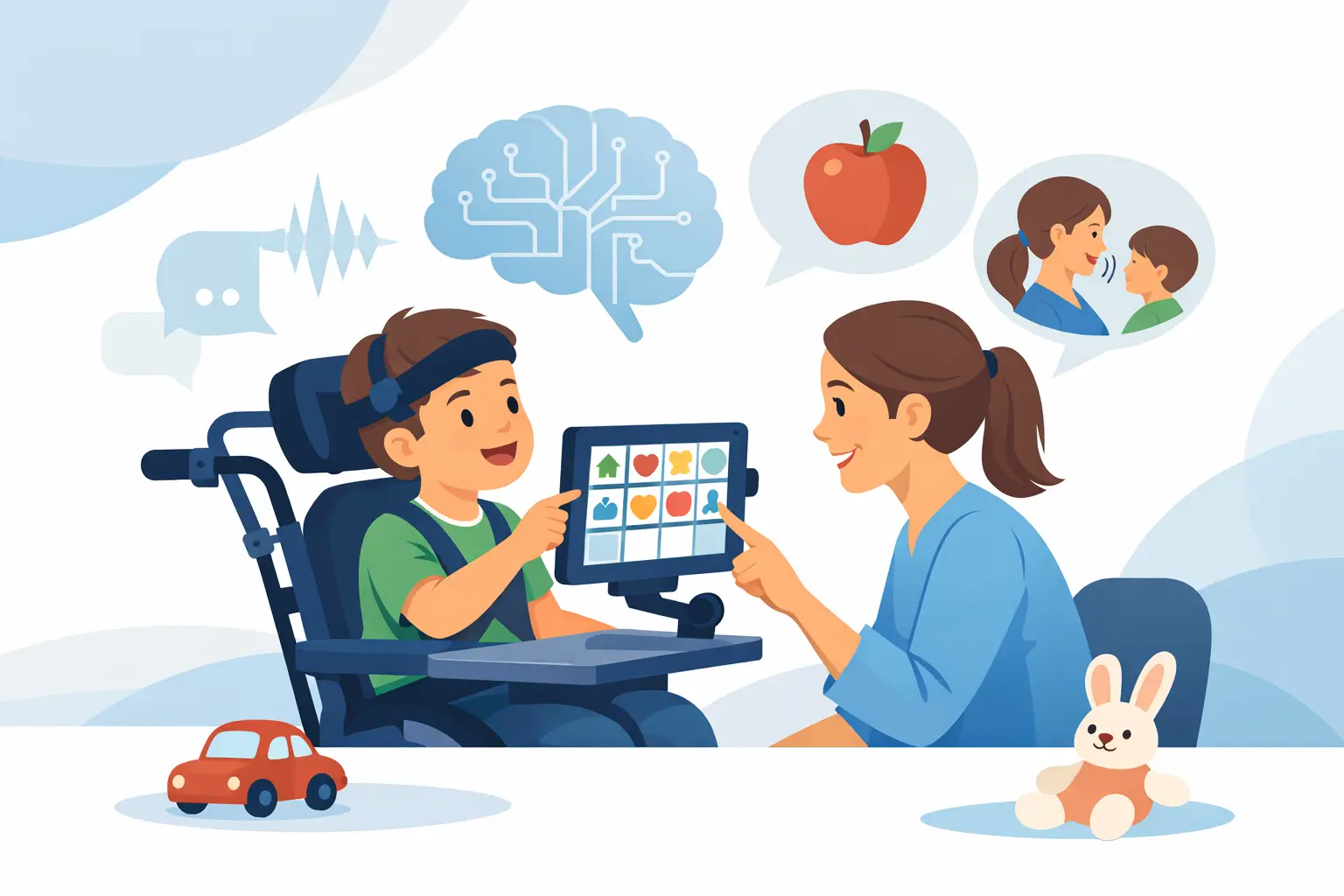
When a child has something to say but their body will not reliably cooperate, the gap can feel enormous. A request for a drink, a joke with a sibling, an answer in class, or a simple “no” should not depend on whether speech is easy that day. AAC for a cerebral palsy child can help close that gap by offering another reliable way to communicate.
AAC does not replace a child’s personality, intelligence, or potential. It gives them a way to show it. For many children with cerebral palsy, communication support means less frustration, more independence, and more opportunities to participate in the ordinary moments that build confidence.
What AAC can look like for cerebral palsy
AAC stands for augmentative and alternative communication. “Augmentative” means it adds to speech. “Alternative” means it provides another route when speech is difficult or unavailable. A child may use AAC alongside vocalizations, facial expressions, gestures, signs, or a few spoken words.
The right system depends on how your child moves, sees, hears, understands language, and prefers to interact. Some children communicate by touching pictures or words on a screen. Others use a keyguard, larger buttons, switches, eye gaze, or partner-assisted scanning, where a communication partner presents choices in a planned sequence. Low-tech options, such as printed communication boards, can also be valuable at home, school, and in the community.
There is no single “cerebral palsy AAC” setup that fits every child. Cerebral palsy affects movement in different ways, and a child’s access method may change with positioning, fatigue, growth, or muscle tone. A communication system should adapt to the child, not ask the child to work around a system that is physically hard to use.
AAC is about more than requesting
It is natural to begin with words for favourite foods, toys, and activities. Those early requests can be motivating because they create a quick, meaningful result. But a full communication system must go further.
Children need language to refuse, comment, ask questions, share feelings, tell stories, join play, and speak up for themselves. They need words for “again,” “stop,” “I don’t know,” “that’s funny,” and “I want to tell you something.” They also need access to the words that make childhood feel social, not just functional.
This matters at school, too. A student who can only request a snack may still be left out of learning discussions. A well-supported AAC system gives them a way to answer, contribute an idea, ask for help, and show what they know. Communication access is participation access.
How to start AAC without waiting for the perfect moment
Many families delay AAC because they are waiting for speech to emerge, an assessment appointment, or certainty about which tool is best. Professional guidance is valuable, especially for access needs and language planning. But your child does not need to earn the right to communicate while everyone waits.
You can begin by making communication visible and available throughout the day. Start with a small set of highly useful words or symbols connected to real routines: eating, getting dressed, playing, reading, bath time, and leaving the house. Keep the system within reach and in a stable position so your child can access it with as much independence as possible.
Then model it. If you are offering a choice, point to or select the relevant words while you speak: “Do you want more music or stop?” If the bubbles are exciting, use the system to say “more” before blowing another bubble. Modelling shows a child that AAC is a language tool, not a test they must pass.
Do not require your child to copy every selection before giving them what they want. Communication should feel powerful, not like a drill. Respond warmly to attempts, including a glance, movement, vocalization, or imperfect selection. Those attempts are information, and they are the beginning of a conversation.
Focus on access before speed
A child may understand exactly what they want to say yet need extra time to make a selection. Slow or inconsistent motor control does not mean a child is not ready for AAC. It means the access method and environment deserve careful attention.
Consider posture, seating, device placement, screen angle, button size, and how much force or range of motion is required. A child who appears to be “not interested” may actually be working too hard to reach the screen accurately. An occupational therapist, speech-language pathologist, and other members of your child’s care team can help assess these details.
It is also reasonable to use more than one access option. A printed board can be useful when a device is charging or when outdoor conditions make a screen difficult. A touch-based system may work well at the table, while eye gaze or switches may be better when fatigue is high. The goal is dependable communication, not loyalty to one format.
Build AAC into real life
AAC works best when it is part of the day, not something brought out only for therapy. The more your child sees it used in genuine conversations, the more they learn that it belongs to them.
At home, place AAC where communication happens: at the kitchen table, beside favourite toys, near the front door, and during bedtime routines. At school, it should be available during instruction, transitions, group work, recess, and specials, not stored away until a designated communication activity.
Consistency does not mean every adult must teach in exactly the same way. It means the important adults agree on a few basics: keep AAC available, model language without pressure, allow wait time, and honour all communication attempts. When parents, educational assistants, teachers, and therapists use the system as a shared tool, children receive a much clearer message: your voice matters everywhere.
Give wait time a real chance
After asking a question or modelling a word, pause. A longer pause can feel uncomfortable for adults, especially in a busy classroom or a rushed morning. But a child may need time to look, plan a movement, navigate the page, and make a selection.
Try silently counting to ten before repeating yourself or offering another option. Watch for signs that your child is processing: a shift in gaze, a hand moving toward the device, a vocalization, or a change in expression. Interrupting too quickly can accidentally take away their turn.
Use progress data to reduce guesswork
AAC growth is not always measured by a growing word count alone. Meaningful progress may look like initiating a greeting, combining two words, using AAC with a new person, recovering from a communication breakdown, or choosing a message independently rather than relying on a familiar adult to interpret.
Tracking these moments helps families and professionals make better decisions. If a child uses “more” frequently but never uses “help,” that may signal a modelling opportunity. If use drops during school hours, the team can look at whether the device is accessible, charged, and included in routines. Data turns vague impressions into useful next steps.
A connected platform such as VoiceBloom can help families start with a symbol-based communication board in minutes while giving therapists and educators visibility into use, goals, and progress. Shared reporting can make conversations between home, clinic, and school more specific, especially when teams are documenting communication goals for an IEP.
The data should support the child, not turn every interaction into a performance metric. A child is allowed to explore, play with sounds, repeat a funny phrase, or choose not to respond. Progress tracking is most helpful when it helps adults notice patterns and remove barriers.
Common concerns parents often carry
One concern is that AAC will stop a child from talking. For children who can develop speech, AAC can support language development by giving them a dependable way to connect words with meaning and participate in more interactions. It does not ask them to give up speech. It gives them another way to be understood while speech develops or when speech is hard to access.
Another concern is starting with the “wrong” system. It is wise to seek input from an SLP and occupational therapist where possible, particularly when specialized access is needed. At the same time, beginning with basic, meaningful communication is rarely wasted. Language exposure, modelling, and the expectation that a child can communicate are valuable from day one.
You may also worry that your child is too young, too frustrated, or not showing enough interest. Readiness is not a test score. If your child has preferences, responds to people, enjoys something, dislikes something, or has a reason to connect, they have something to communicate.
Give your child access to words before they can show you every word they know. Keep the system nearby, model without pressure, and celebrate every honest attempt to be heard. A voice can grow one meaningful moment at a time.