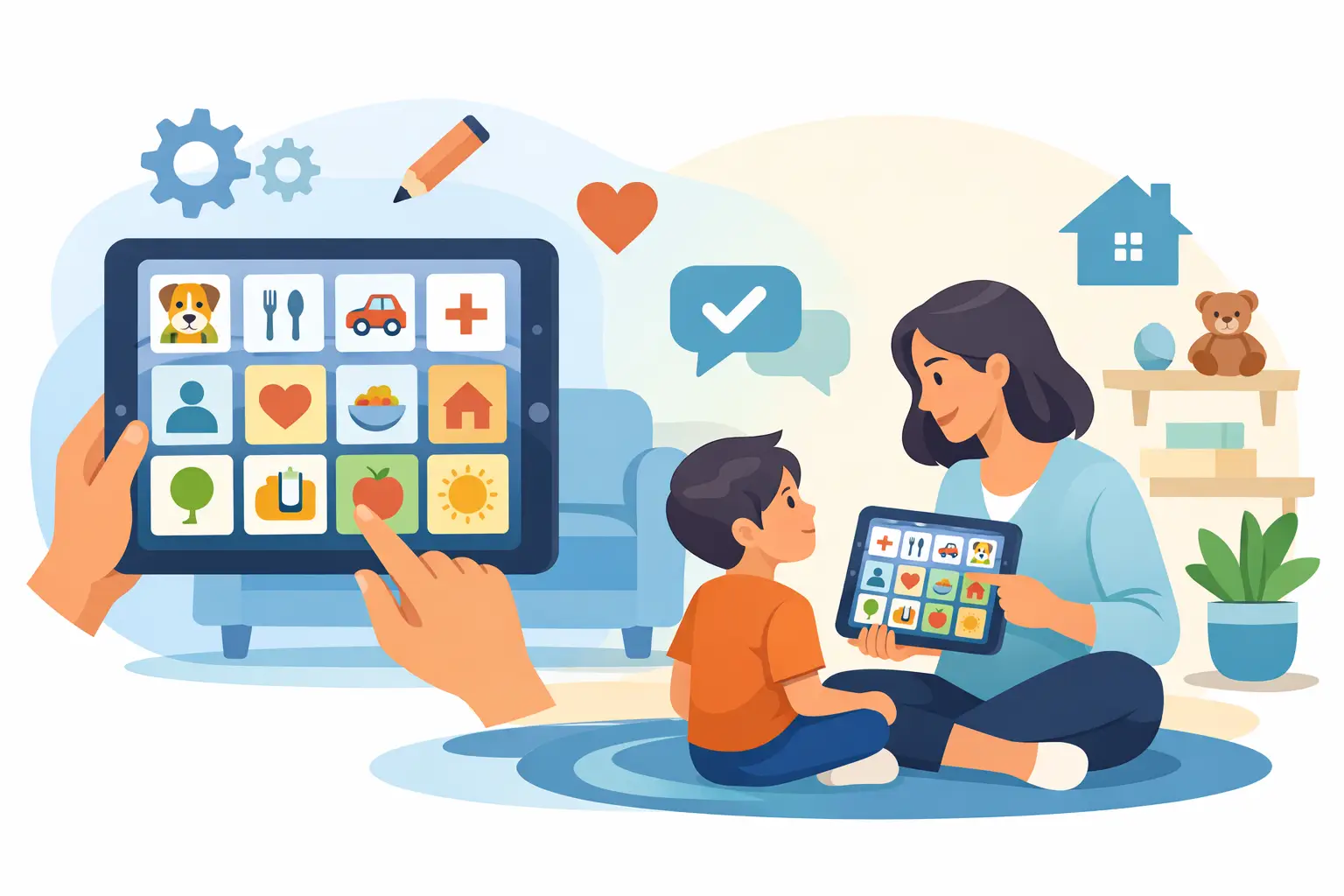
The words missing from an AAC board are often the words a child needs most at that moment: the name of a favourite snack, a beloved grandparent, “again” during a game, or “stop” when something feels wrong. You can customize AAC vocabulary quickly without building an enormous board or waiting until every decision feels perfect. The goal is not to predict every word your child may ever use. It is to make communication more useful, more personal, and easier to practise right now.
For families, this can mean starting in minutes with a few high-value additions. For speech-language pathologists and school teams, it means creating a shared system that supports real communication across settings, not a board that only makes sense during one therapy activity.
Start With Words That Change Your Child’s Day
When AAC vocabulary is personalized, it should reflect the child’s actual life rather than an adult’s idea of what belongs on a communication board. A child who loves trains may have far more reason to communicate with “train,” “go,” “fast,” “again,” and “more” than with a long page of generic classroom nouns.
Begin by watching for moments when your child reaches, points, leads you somewhere, becomes frustrated, or repeats a sound or movement. Those moments reveal a communication need. Ask yourself: what would they say if the word were easy to access?
Choose a small number of words that will have an immediate purpose. The best first additions are usually a mix of personal words and flexible words. Personal words include names, preferred foods, activities, places, pets, and familiar people. Flexible words include core vocabulary such as “want,” “help,” “go,” “more,” “not,” “like,” “stop,” and “finished.”
Personal words give AAC meaning. Core words give a child building blocks they can use in many situations. One without the other can be limiting. A board with only favourite items may make requesting easier but leave little room for protesting, commenting, asking for help, or sharing an opinion.
Customize AAC Vocabulary Quickly: Use the “Today” Test
A useful filter is simple: could your child use this word today, in a real interaction? If the answer is yes, it is probably worth prioritizing.
Think through a normal day. At breakfast, a child might need “eat,” “drink,” “more,” “all done,” “toast,” or “banana.” During dressing, “shirt,” “help,” “no,” “cold,” and “blue” may matter. At the park, “swing,” “go,” “up,” “stop,” “my turn,” and “again” can create many chances to connect.
Do not try to add every related word at once. A page with too many new symbols can make it harder for a child to find what they need, especially while they are still learning where words live. Add a few words, model them consistently, then review what is working.
The “today” test also helps teams avoid vocabulary that is technically relevant but rarely used. A word may fit an IEP goal yet not be useful in the child’s everyday life. That does not mean it should never be taught. It means it may not deserve the most accessible spot on the board right now.
Protect Familiar Locations and Motor Learning
Speed matters, but consistency matters too. Once a child begins to learn where a symbol is located, moving it often can create unnecessary frustration. AAC access involves motor learning: finding a word can become easier when its location stays stable over time.
When adding vocabulary, look for open spaces or category pages before reorganizing the whole system. Keep frequently used core words in predictable locations. If a major change is necessary, make it deliberately and give caregivers, educators, and the child time to adjust.
This is one of the trade-offs in customization. A highly personalized board can feel immediately relevant, but constant redesign may make navigation harder. A stable core with carefully added personal vocabulary is usually the most practical balance.
It also depends on the child. Some children benefit from a simple display with fewer choices, while others are ready for more language available on one screen. Access needs matter as much as vocabulary needs. Consider vision, attention, motor control, literacy, sensory preferences, and whether the child uses direct touch, scanning, or another access method.
Add Language for More Than Requests
Many adults naturally start AAC by teaching requests: “cookie,” “iPad,” “outside.” Requesting is valuable because it gives children a clear reason to use the system. But a voice should never be limited to asking for things.
Make room for words that help a child refuse, direct, connect, and be heard. “No,” “wait,” “different,” “don’t like,” “look,” “funny,” “hurt,” and “I want to go” can be powerful additions. So can social words such as “hi,” “bye,” “thank you,” and “my turn.”
Children also need access to language that may make adults pause. “Stop,” “no,” “leave me alone,” and “I’m mad” are not negative vocabulary. They are communication rights. If a child can only say yes, more, and favourite items, adults have too much control over the conversation.
For professionals, this broader vocabulary supports meaningful goals and stronger evidence of functional communication. For parents, it can reduce guesswork and help a child take a more active role in daily routines.
Model First, Then Give Time
Adding the right words is only half the work. Children learn AAC when the people around them use it too. This is often called aided language modelling: you speak naturally while selecting a few relevant symbols on the child’s system.
If you are offering bubbles, you might say, “Want more bubbles?” and select “want” and “more.” You do not need to select every word you say. Keep it natural, repeat the opportunity, and pause. The pause is important. It gives the child time to look, reach, respond, or simply take in what happened.
Avoid turning every interaction into a test. Instead of asking, “What do you want?” repeatedly, model the language in the moment. Say, “I want bubbles,” then wait. If your child communicates in any way - through AAC, gesture, eye gaze, sound, or movement - respond as though their message matters. Because it does.
Build One Shared Vocabulary Plan
AAC works best when the child does not have to relearn communication rules at home, at school, and in therapy. A new food word may be useful at home, while a peer’s name or a class activity may matter more at school. Both belong in the child’s system, with the same key core vocabulary available wherever possible.
A simple shared note can prevent confusion. Record newly added words, where they are located, the routines where they are being modelled, and any words the child is using independently. Review it regularly with the SLP, educator, educational assistant, and other caregivers.
Usage data can make these conversations more specific. If a child uses “more” frequently but never selects “help,” the issue may be vocabulary, placement, modelling, or the fact that adults are anticipating needs too quickly. Data does not replace professional judgement, but it can show patterns that are easy to miss during busy days.
VoiceBloom brings vocabulary, communication activity, and collaboration into one connected space, helping families and professionals make adjustments without guessing from memory alone.
Review What Is Working Every Week
Set aside a few minutes each week to notice what has changed. Which words did your child use? Which words did adults model often? What situation still caused frustration? Remove or move only what truly is not serving the child, and add the next small set of meaningful words.
Look beyond independent button presses. Progress may appear as looking toward the device, accepting it during a routine, watching you model, reaching for a symbol, using a word after support, or using one message in a new setting. These are meaningful steps toward confident communication.
If your child has an SLP, involve them in larger layout decisions, access concerns, and language goals. If you are waiting for services or between appointments, you do not need to wait to make a useful start. Personal, everyday vocabulary and respectful modelling are valuable now.
The best AAC board is not the one with the most symbols. It is the one that gives your child a reliable way to say something that matters - and gives the adults around them a clear reason to listen.