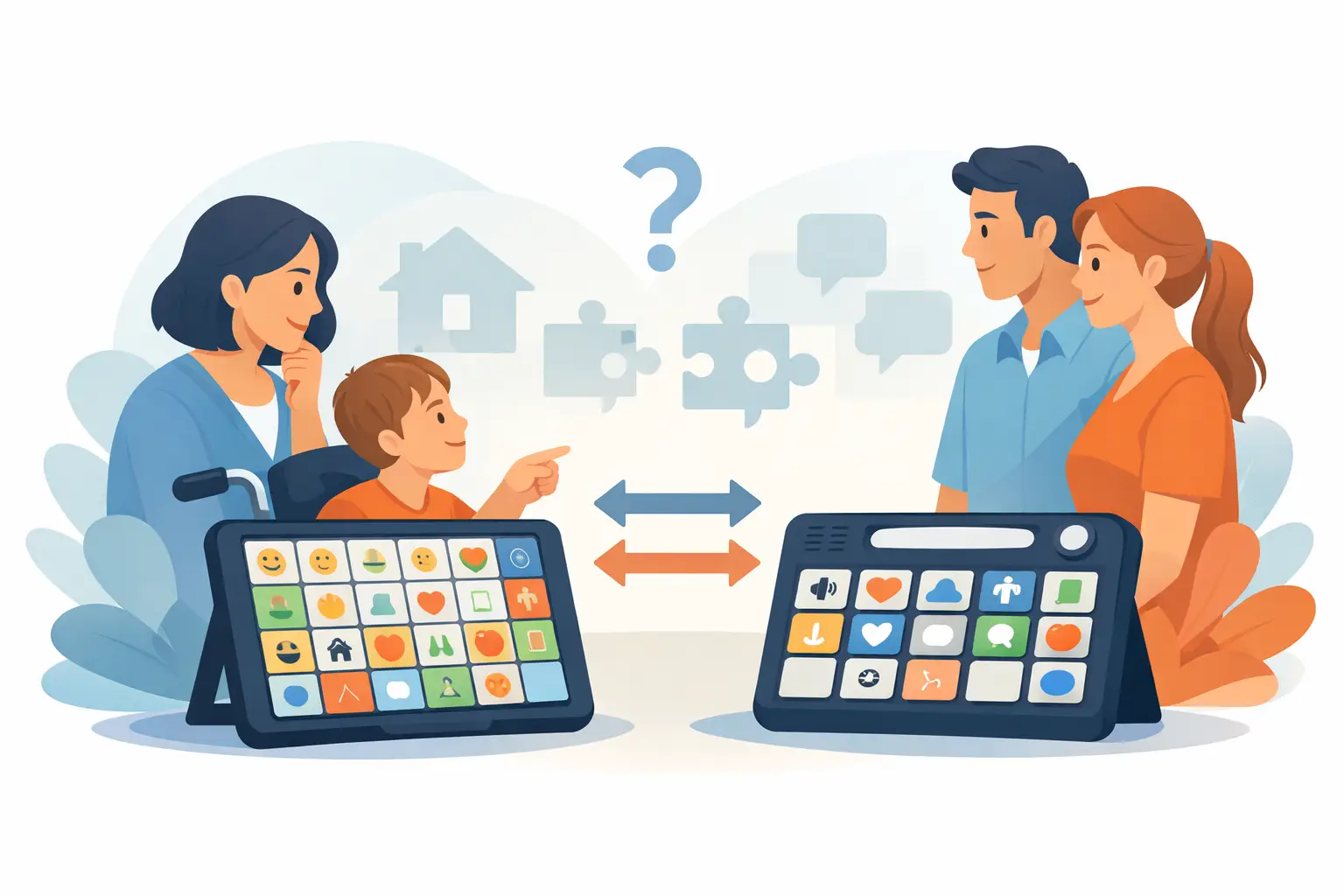
A dedicated AAC device comparison is rarely just about choosing a screen. For a child who is non-verbal or minimally verbal, the right system can mean being able to ask for help at school, tell a parent what hurts, join a joke at dinner, or make a choice without waiting for someone to guess. The decision deserves care, but it does not need to feel overwhelming.
Dedicated speech-generating devices and AAC apps on consumer tablets can both support meaningful communication. The better choice depends on your child's access needs, your family's routines, the school environment, and how much support you need to keep communication growing over time.
What makes a device "dedicated"?
A dedicated AAC device is built and configured primarily for communication. It may look like a tablet, but it is designed to be a child's reliable voice rather than a general-purpose device. Many offer durable cases, amplified speakers, mounting options, extended warranties, and dedicated technical support. Some can be locked so the child cannot switch from their communication system to games or videos.
This focus can be valuable. When a child learns that a device is always available for communication, adults around them are more likely to model language consistently. It can also reduce the painful moment when a shared family tablet is out of battery, left at home, or needed by someone else.
That said, dedicated does not automatically mean better for every child. A purpose-built device may be expensive, take longer to obtain, or offer fewer options for collaboration and progress tracking than a modern AAC platform. The best solution is the one your child can access, use often, and carry across real life.
Dedicated AAC device comparison: what matters most
It is easy to compare devices by screen size, button layout, or price. Those details matter, but they should come after the questions that shape daily communication.
Reliable access comes before features
Start with how your child will physically use AAC. Can they accurately touch a small symbol? Do they need a larger screen, a keyguard, switch access, eye gaze, or a mount for a wheelchair? Is a loud speaker necessary for a busy classroom or playground?
A dedicated device may have an advantage when a child needs specialised access hardware or a highly durable setup. For a child who can directly select symbols on a standard tablet, however, an app-based system may offer a faster and less costly place to begin. A speech-language pathologist or occupational therapist can help assess access, but families should not feel they must wait to begin modelling communication in the meantime.
Availability is a communication feature
A device only supports communication when it is nearby, charged, and ready. Think through a typical week: breakfast, the car, therapy, school, after-school activities, visits with grandparents, and bedtime. Who carries the device? Who charges it? What happens if it is dropped, lost, or sent home in the wrong backpack?
Dedicated devices are often chosen because they make this role clear. They belong to the child and are treated as their voice. A tablet can work just as well when it has a protective case, a reliable charging routine, and clear boundaries around communication use. The important issue is not the label on the hardware. It is whether adults make AAC available all day, not only when it is convenient.
Vocabulary needs room to grow
Early AAC users need words for favourite foods and familiar people, but they also need language for refusing, protesting, commenting, asking questions, telling stories, and sharing a personality. Be cautious of systems that look simple because they offer only a small set of request-based buttons. A child should not have to earn access to richer language.
Look for a symbol-based vocabulary that can begin simply while preserving a path to more words, sentence building, and literacy. The layout should be stable enough for motor learning. In practical terms, that means a word should stay in a predictable location rather than moving around whenever a new page is added.
The right amount of vocabulary varies. Too many symbols on a page can make access difficult for some children; too few can limit what they are able to say. A flexible system lets the team adjust the display without stripping away the chance to communicate something new.
Support should reach beyond setup day
A device can arrive fully configured and still sit unused if the people around the child do not know how to model it. Families often need answers after the first week: Which words should we add? Why is my child pressing the same button repeatedly? How can we use AAC during routines without turning every interaction into a lesson?
This is where the difference between a standalone tool and a connected communication system becomes clear. Look for practical coaching, usage insights, and a way to share what is happening at home with the professionals supporting your child. Support should reduce guesswork, not add another portal for busy caregivers to manage.
VoiceBloom is designed around this need, combining a symbol-based communication board and speech output with coaching, progress tracking, and collaboration tools that help parents, therapists, and educators work from the same picture.
Progress data should be useful, not just impressive
Schools and therapy teams may need documentation for goals, meetings, and IEP planning. Parents also deserve to see more than a vague sense that AAC is or is not working. Useful data can show which words are being used, when communication happens most often, and where a child may need more modelling or access support.
Data has limits. A button count does not measure everything a child understands, feels, or intends. It should never replace observation or a clinician's judgement. But when used thoughtfully, it can reveal patterns that memory misses, such as a child communicating far more at home than at school, or using a word independently after repeated modelling.
Choose a system that turns information into a clear next step. A weekly report is only helpful if it helps an adult decide what to model tomorrow.
Cost, funding, and the real value of flexibility
Dedicated devices can range from a significant purchase to a major funding application. In Canada, funding pathways differ by province, school board, insurer, and family circumstance. Some programs may require an assessment, specific supplier, or formal recommendation. Ask about warranty coverage, repairs, replacement timelines, accessories, and whether the device will remain with your child if they change schools.
A tablet-based AAC platform can lower the barrier to starting because many families already have compatible hardware or can begin with a less expensive device. Subscription costs should still be considered honestly, especially if you need professional reporting or multi-user collaboration. Compare the total cost over a year or two, not only the initial price.
Flexibility has value as well. Children's access skills, vocabulary, interests, and environments change. A system that can adapt without a complete restart may protect both your investment and your child's learned motor patterns.
Questions to ask before you choose
Before committing to a dedicated device or an AAC platform, ask whether your child can access it comfortably, whether it can travel reliably through their day, and whether it supports language beyond requesting. Ask how quickly you can begin, how adults will learn to model it, and what happens when your child needs a different layout or access method.
For professionals, ask whether home and school use can be viewed together, whether reports are meaningful enough for goal planning, and whether caregivers can act on the information without needing extensive technical training. The strongest plan is one that does not leave families carrying the whole implementation alone.
Start with the communication opportunity in front of you
Waiting for the perfect setup can unintentionally delay the moments that build confidence: choosing a snack, greeting a sibling, objecting to a loud room, sharing a funny thought. A dedicated device may be the right long-term answer, especially when specialised access, durability, or funding eligibility are central needs. For other families, a flexible platform on familiar hardware may be the most immediate and sustainable start.
Give your child a system that is available, respected, and used by the people who love and support them. The goal is not to own the most specialised device. It is to help your child be heard more often, with less guessing, in the life they are living now.