A child reaches for the bubbles, looks at you, and waits. You may be tempted to ask, “What do you want?” But when you know how to model core words, you can show a faster path: tap or say “more” while offering another bubble. No quiz. No pressure. Just a clear example of communication that works.
Modelling core words is one of the most practical ways to help a child learn to use AAC. It gives them repeated, meaningful exposure to the words that can help them ask, protest, connect, comment, and participate throughout the day. You do not need to wait for a therapy session or know every feature of an AAC system to begin.
What are core words in AAC?
Core words are high-frequency words that are useful in many settings. Words such as more, go, stop, want, help, like, not, in, and you can be combined in many ways and used across activities.
They are different from fringe words, which are more specific words such as bubbles, truck, banana, or grandma. Fringe words matter too. They help a child talk about the people, places, favourite foods, interests, and routines that make communication personal. Core words provide the flexible building blocks that make those messages go further.
For example, “more” can be used for crackers, music, swinging, tickles, painting, or another turn in a game. “Stop” can be used when a noise is too loud, a game is no longer fun, or a child needs a break. That versatility is why core words deserve a consistent place on an AAC board or device.
How to model core words without turning it into a test
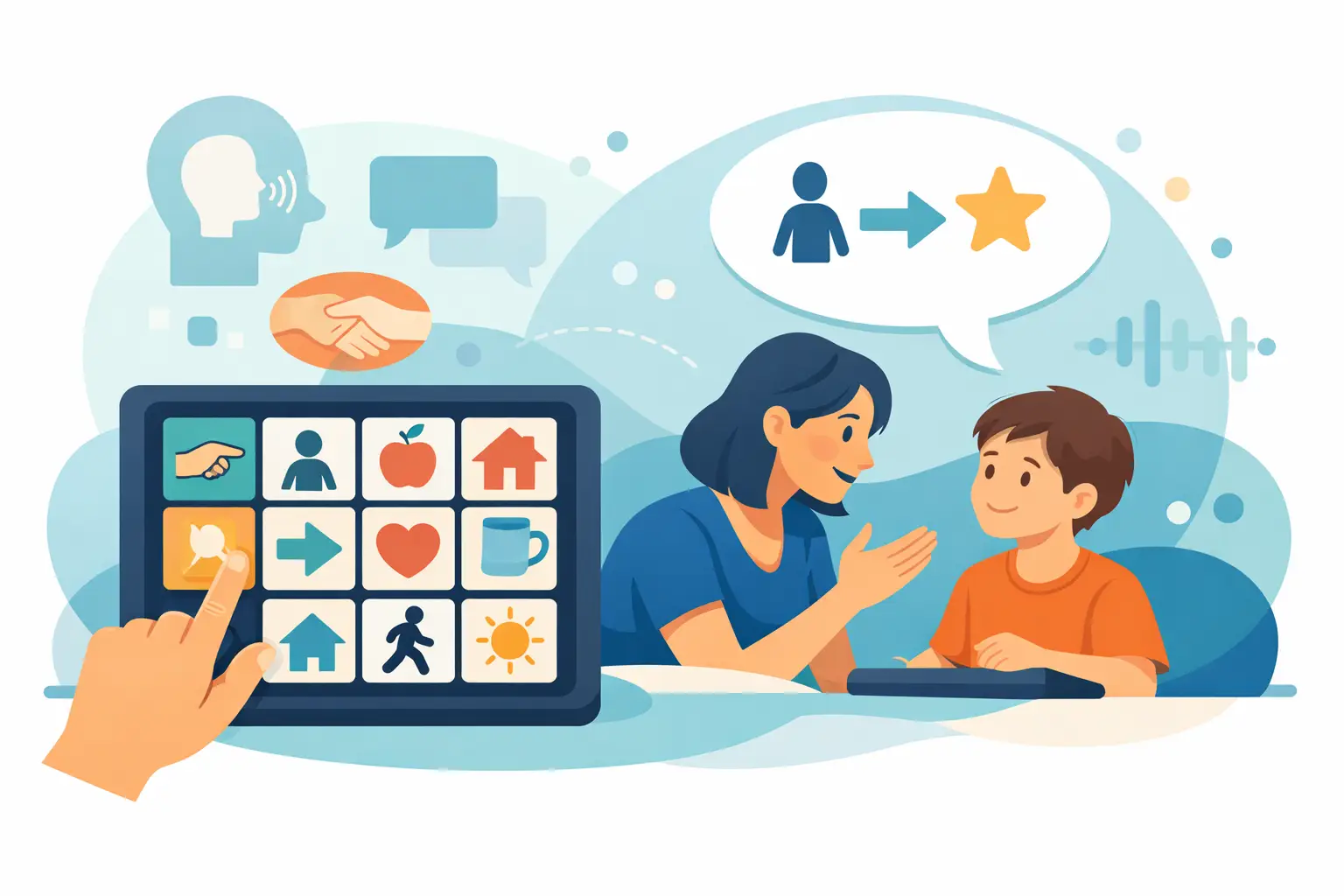
Modelling means using AAC yourself while you speak naturally. If your child uses a speech-generating device, touch the matching symbol as you say the word. If they use a printed board, point to the word. This approach is often called aided language input or aided language stimulation.
The goal is not to make your child copy you immediately. The goal is to show them where words are and how AAC can be used to make something happen. Children learning AAC need to see their communication system used many times before they can be expected to use it independently.
Think of how children learn spoken language. They hear thousands of words before saying them clearly. AAC deserves the same patient exposure. If you model “go” before pushing a swing, then do it again before starting the car, sending a toy down a ramp, or beginning a favourite song, that word becomes connected to real experiences.
Keep your model shorter than what you say out loud. You might say, “Let’s make the car go fast,” while tapping only “go” on the AAC system. One or two key words is enough. Trying to find and select every word in a sentence can make the interaction feel slow and difficult for both of you.
Start with words that create a result
The best first core words are often the ones that give a child more control right away. Consider more, go, stop, help, open, want, and all done. These words fit naturally into daily life and show a clear cause and effect.
At snack time, model “open” before opening a container and “more” before giving another bite. During play, use “go” to start a toy and “stop” to pause it. When a lid is tricky or a toy is out of reach, model “help” before stepping in.
Pause after modelling, but do not make the pause feel like a demand. Give your child time to look, reach, vocalize, touch the screen, or respond in their own way. If they do not respond, continue the activity and model again at the next natural opportunity. Communication grows best when it stays connected to something worth communicating about.
Make AAC available before the moment passes
A core word cannot be modelled if the AAC system is across the room, out of charge, or packed away for “practice time.” Keep the device or communication board close during routines where your child is motivated to interact.
This may mean bringing it to the table, outside, into the bath routine, or beside the couch during a favourite show. If your child uses a device, make sure it is charged and easy to reach. If they use a paper board, consider placing copies in the spaces where communication happens most.
Access matters just as much as vocabulary. A child who needs help pointing, holding a device, or seeing symbols clearly may benefit from positioning changes, larger buttons, keyguards, or support from an occupational therapist or speech-language pathologist. The right setup depends on the child. The aim is always the same: make communication possible when they have something to say.
Use everyday routines, not extra homework
You do not need to create an hour of AAC instruction each day. The most effective opportunities are often already part of your family life. Choose one routine and one or two words to model consistently for a week.
Morning dressing can include “on,” “off,” “help,” and “not.” Meals can include “more,” “want,” “drink,” and “all done.” At the park, try “go,” “up,” “down,” “again,” and “stop.” During a book, model words such as “look,” “like,” “turn,” and “where.”
Follow your child’s interests whenever possible. If they love trains, you do not need to move away from train vocabulary to teach core words. Add core words to the interest: “go train,” “more train,” “train stop,” or “want train.” A child is more likely to notice and learn when the message relates to something they genuinely care about.
Model for more than requesting
Requesting is a useful starting point because it often leads to an immediate result. But every child deserves language for more than asking for things. Model core words for refusing, sharing opinions, gaining attention, commenting, and connecting with others.
You can model “not” when your child turns away from a food, “like” when they smile at a song, “fun” during a silly game, or “look” when something interesting happens outside. Model “I” and “you” in social moments: “I go,” “you go,” “I like,” or “you help.”
This matters because communication is not simply a way to earn a preferred item. It is a way to be known. When adults model a broader range of messages, children learn that AAC can carry their choices, humour, opinions, protests, and personality.
Respond to every communication attempt
A child does not need a perfect button press to deserve a response. Looking at the device, reaching toward it, touching near a symbol, making a sound, using a gesture, or combining AAC with speech can all be meaningful attempts to communicate.
Acknowledge the attempt, interpret it using the context, and model the word you think they may be expressing. If your child pushes a toy away, you might say, “Stop. You said stop,” while selecting stop on the AAC system. If they look toward the snack cupboard, model, “Want snack?” and offer a choice.
Responding this way reduces frustration and teaches a powerful lesson: communication changes what happens. It also avoids a common trap of repeatedly saying, “Use your words,” when a child may not yet know how to find the words they need.
Keep the team using the same approach
Consistency helps, but it does not mean every adult must model the same script. It means caregivers, educators, and therapists share a few useful words and use them in real situations. A quick note such as “We are modelling more, help, and all done at snack this week” can make home and school feel more connected.
For professionals, brief usage data can make this collaboration more specific. It can reveal which words are being used, when communication is most active, and where additional modelling may help. A connected platform such as VoiceBloom can support that shared view while giving families practical coaching based on everyday use.
What progress can look like
Progress does not always begin with independent sentences. Your child may first watch you model, touch the screen without a clear message, use one word repeatedly, or begin using a symbol in a new setting. These are meaningful steps.
Look for growing awareness, more intentional choices, less frustration in familiar routines, and more ways to participate. Some children will begin using core words quickly. Others need more repetition, different access supports, or a smaller set of words at first. There is no single timeline, and comparison rarely helps.
Keep modelling even when your child does not appear to be watching. Learning can be quiet before it becomes visible. Choose one real moment today - a snack, a game, a walk to the car - and show one word that could make that moment easier, clearer, or more joyful. Every model says the same thing: your child has something worth communicating.