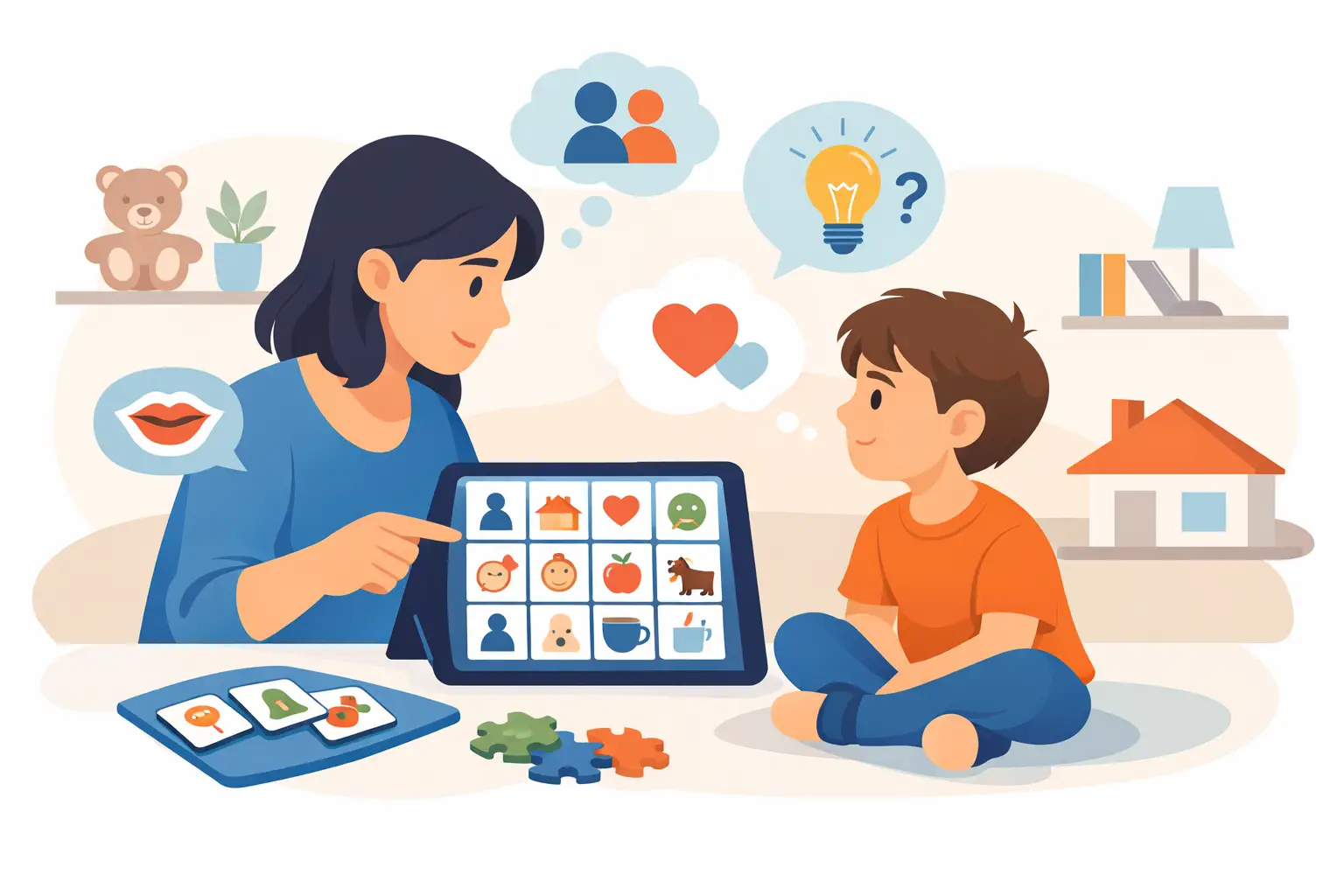
The first time you hand your child an AAC tool, it can feel bigger than it looks. Parents often worry about doing it wrong, choosing the wrong words, or somehow making speech less likely. If you are wondering how to start AAC at home, the good news is this: you do not need to wait until everything feels perfect to begin.
AAC works best when it becomes part of real life, not a special activity saved for therapy. That means the most helpful starting point is not a long word list or a complicated setup. It is choosing a simple system, using it during familiar routines, and giving your child many low-pressure chances to communicate without guessing what they need.
What AAC really means at home
AAC stands for augmentative and alternative communication. It includes any tool that helps a person express themselves beyond speech alone, from symbol boards to speech-generating devices. For many children, AAC does not replace speech. It supports language growth, reduces frustration, and gives them a clearer way to participate.
At home, AAC matters because home is where communication happens most often. Your child asks for snacks, protests bath time, comments on the dog, chooses a show, and asks for help with favourite toys. Those everyday moments are not small. They are the practice ground for real communication.
That is why waiting for the "right time" can slow progress. If your child has difficulty getting their message across, they can start learning that communication has power now. Not later, not only in therapy, and not only with a specialist present.
How to start AAC at home with less pressure
The best home start is usually smaller than parents expect. You do not need to teach every symbol at once. You do not need your child to sit at a table for a lesson. And you do not need to test them.
Start with access. Your child needs an AAC system that is available during the day, easy enough to begin using, and built around words they can use often. In the early stages, consistency matters more than complexity.
For some families, this means a printed board with core words and a few motivating fringe words. For others, it means a speech-generating app or device with symbols and voice output. What matters most is that the system is visible, available, and not locked away until the "right" moment.
Then shift your goal. The first goal is not perfect use. It is helping your child learn, "When I use this, people understand me." That one lesson changes everything.
Choose a starting setup your family can actually maintain
A common mistake is choosing a system that looks impressive but is too hard to use consistently. A better question is not "What is the most advanced option?" It is "What can we use every day without burning out?"
If your child is just starting, look for a setup with clear symbols, a manageable layout, and words that fit many situations. Core words such as more, help, stop, go, want, like, not, and all done are often useful because they carry across meals, play, getting dressed, and community outings.
Fringe words still matter, especially if they connect to what your child loves. If dinosaurs, yogurt, bubbles, or trains are highly motivating, include them. Motivation keeps communication moving. The trade-off is that favourite nouns alone will not support broader language growth, so a strong AAC setup usually includes both everyday core words and meaningful personal vocabulary.
If you are using a digital platform, simplicity is a strength. A system that lets parents start in minutes, model language clearly, and track use over time can reduce a lot of uncertainty. VoiceBloom, for example, is built around that exact need: helping families begin AAC at home without waiting for a full clinician-led setup.
Model first, expect less
One of the most effective ways to teach AAC is also one of the easiest to miss. Your child needs to see AAC being used before they are expected to use it on their own.
This is called modelling. If your child wants more crackers, you might say "more" while selecting the symbol for more. If they are pushing something away, you can model "not" or "all done." If they are running to the door, you can model "go." You are not asking them to copy you every time. You are showing them how the system works during real communication.
Many parents worry they are not modelling enough or doing it correctly. The truth is, a few meaningful models each day can be more useful than a long forced session. Think natural, brief, and connected to what your child already cares about.
There is also a balance to strike. Too much prompting can make AAC feel like a test. Too little support can leave your child unsure where to start. A good middle ground is to model a word, pause, and leave space. If they respond in any way, by touching a symbol, looking, vocalizing, or gesturing, treat that as communication and build from there.
Use AAC in routines your child already knows
If you want to know how to start AAC at home in a way that sticks, begin with routines that repeat every day. Repetition gives your child more chances to connect symbols with meaning.
Snack time is often a strong starting place because there are built-in reasons to communicate. Your child may want more, different, open, help, or all done. Play is another natural entry point. Bubbles invite words like more, go, pop, and stop. Books can support turn, look, like, and again. Bath time can bring in wash, in, out, hot, cold, and done.
You do not need to target many words at once. In fact, too many targets can make the process feel scattered. Pick one or two useful words for a routine and model them consistently for several days. Once those words feel familiar, add another.
This is also where caregiver consistency matters. If one adult uses AAC during meals, another during play, and another during dressing, the child gets a stronger message that AAC belongs everywhere.
What to do if your child does not use it right away
This is one of the hardest parts for families. You start, you model, you offer chances to communicate, and your child seems uninterested. That does not mean AAC is not working.
Many children need time to watch before they participate. Some will press buttons repeatedly to explore the sounds. Some will appear to ignore the system while still learning from it. Some will use AAC first for requesting, then much later for commenting, protesting, or asking questions.
Progress is not always linear. It depends on your child’s motor skills, attention, language level, sensory profile, and how often the system is available. A child with apraxia may understand more than they can physically express. A child with autism may use AAC more during familiar routines than during open-ended social moments. A child with cerebral palsy may need access adjustments before language can really show up.
The key is to watch for small signs of growth. Are they looking toward the board? Tolerating it longer? Reaching for a symbol? Anticipating a word you model often? Those changes count.
Reduce frustration by changing the environment, not the goal
If AAC use feels difficult at home, families often assume they need to try harder. Sometimes the better move is to make the environment easier.
Keep the system within reach. Use it before a child is upset, not only during meltdowns. Build in pauses so they have a chance to respond. Avoid quizzing. Instead of asking, "What do you want?" over and over, try modelling "want" and then showing likely choices.
It also helps to accept multiple forms of communication. AAC does not need to be all or nothing. A child might point, vocalize, gesture, and use symbols in the same interaction. That is still communication. The goal is not to force one method. The goal is to help them be understood more easily and more often.
Bring therapists and school into the same picture
Home is a powerful place to start, but AAC grows faster when the people around the child are aligned. If your child has an SLP, occupational therapist, educational assistant, or classroom team, share which words you are modelling and which routines are going well.
This matters because mixed approaches can slow things down. If school uses one vocabulary set and home uses another, or if one team expects performance while another focuses on modelling, the child may get inconsistent support. Collaboration does not mean everyone must do things identically. It means the core communication goals are clear.
When families can track usage and share progress, those conversations become much easier. Instead of relying on memory, adults can look at patterns, what words are being used, when communication is happening, and where extra support is needed.
Starting AAC at home is not about becoming your child’s full therapy team. It is about creating a daily communication environment that gives them more ways to be heard. You do not need to know everything before you begin. You need a tool your child can access, a few words that matter, and the confidence to use it in ordinary moments. That is often where the biggest changes begin - not in a clinic room, but at the kitchen table, on the living room floor, and in the spaces where your child is already trying to connect.