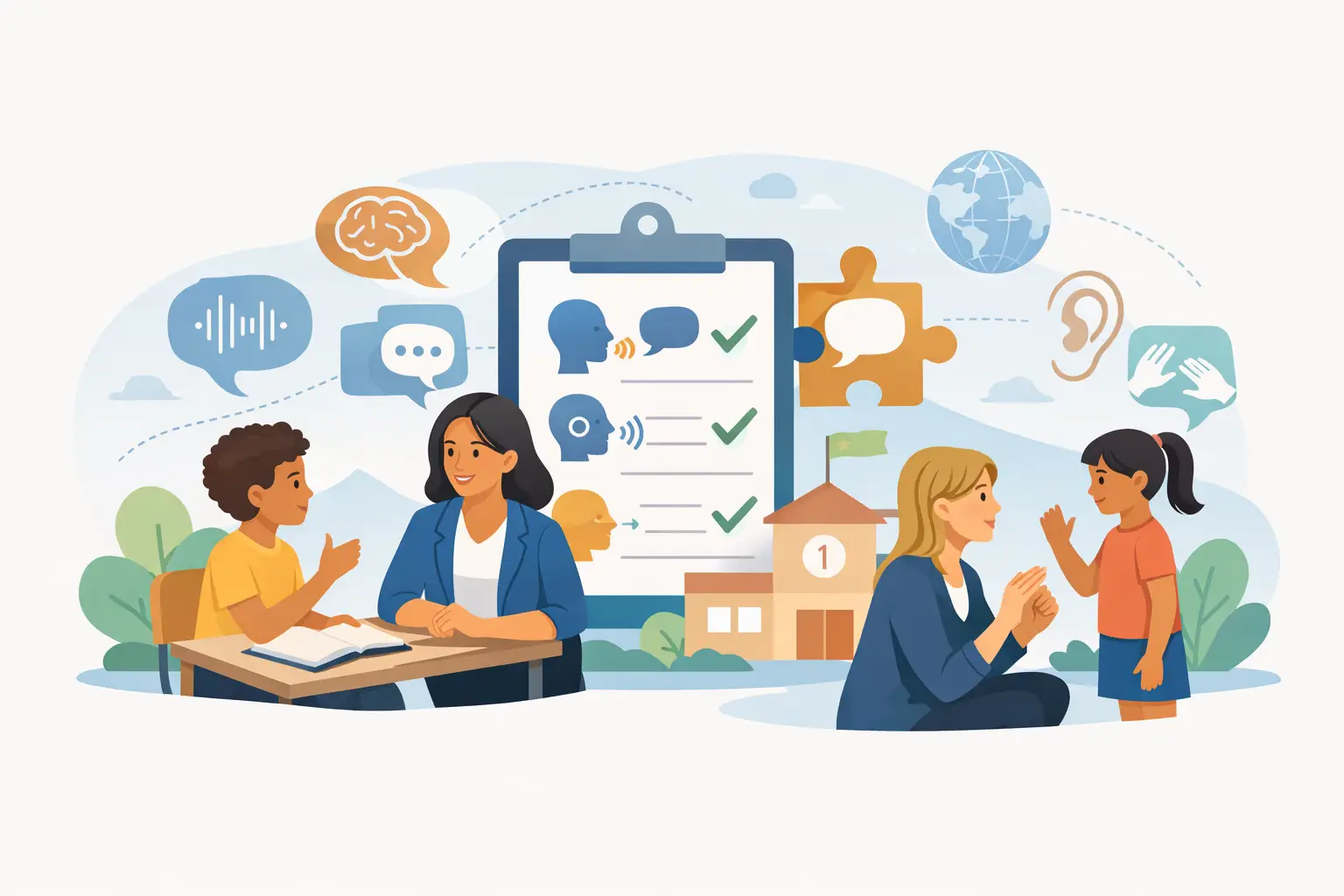
A child who has a reliable way to say “no,” ask for help, share an idea, or repair a misunderstanding is building far more than a school skill. They are building agency. The best IEP communication goals examples protect that agency by focusing on meaningful participation, not simply producing the right response on demand.
For families, educators, and speech-language pathologists, the challenge is turning a broad hope - “I want my child to communicate more” - into a goal that is clear, achievable, and easy to measure across school, therapy, and home. This is especially relevant for children who use AAC, gestures, signs, pictures, or a combination of communication methods.
What makes a communication goal useful?
A useful IEP goal describes what the child will do, in which situation, with what support, and how progress will be measured. It should be ambitious enough to open new opportunities while remaining grounded in the child’s current skills, interests, access needs, and communication system.
For example, “will improve communication” is too broad to guide daily support. It does not tell an educator what to model, a parent what to notice, or a school team what counts as progress. “During familiar classroom and play routines, will use their preferred communication method to make a choice between two meaningful options in four of five opportunities across three weeks” gives everyone a practical target.
The method matters. A child may communicate through an AAC device, paper board, sign, gesture, vocalization, eye gaze, typing, or speech. Goals should not require a particular mode unless that mode is genuinely needed for access. Communication is the outcome. The tool is the pathway.
In Canada, IEP formats and terminology can vary by province, board, and school. Still, the same principle applies: goals work best when they are individualized, observable, and connected to everyday participation.
IEP communication goals examples for AAC users
The examples below are starting points, not copy-and-paste prescriptions. A goal should be adjusted for the child’s baseline, vocabulary, motor access, sensory needs, preferred communication partners, and the routines that matter most to them.
Requesting something meaningful
Goal: During classroom, meal, or play routines, the student will use their AAC system or another preferred communication method to request a desired item, activity, action, or assistance in four out of five opportunities over three consecutive data-collection periods.
This goal can be a strong early target when a child is learning that communication changes what happens around them. Keep the requests meaningful. Asking for a favourite song, more bubbles, a break, help opening a container, or a turn with a toy is more motivating than repeatedly requesting a flashcard item.
Rejecting, protesting, and requesting a break
Goal: When an activity, item, or demand is unwanted, difficult, or finished, the student will communicate a refusal, protest, or request for a break using their preferred communication method in 80% of observed opportunities, with no more than one prompt.
This is a vital goal, not a behaviour-management add-on. A child who can say “stop,” “not that,” “all done,” or “break” has a safer and more respectful way to communicate discomfort and boundaries. The team should honour these messages whenever possible. If “no” never works, there is little reason for the child to keep using it.
Making comments and sharing attention
Goal: During shared reading, play, community outings, or classroom activities, the student will make a relevant comment, observation, or shared-attention message using their preferred communication method at least three times within a 20-minute activity, across four of five sessions.
Requesting is only one reason people communicate. Comments such as “funny,” “I see it,” “big truck,” “wow,” or “I like this” help a child connect with others without needing something in return. This goal may require adults to pause, model language on the AAC system, and respond as genuine conversation partners rather than testing for a correct answer.
Participating in turn-taking conversations
Goal: In a familiar conversation, game, or group activity, the student will take at least three communicative turns with an adult or peer using speech, AAC, gesture, sign, or a combination of methods in four out of five opportunities.
A communicative turn does not have to be a full sentence. It may be a look, a selection on a device, a gesture, a question, a comment, or a response. For some students, the right first step is taking one turn with a trusted adult. For others, the goal can gradually shift toward peer interaction, less familiar partners, or longer exchanges.
Answering and asking questions
Goal: Given access to their communication system and appropriate wait time, the student will answer familiar “what,” “where,” or “who” questions related to an immediate activity in four out of five opportunities across three weeks.
For students ready for a broader social role, a related goal may be: During structured and natural interactions, the student will ask a relevant question or seek information using their preferred communication method at least once per activity in four of five observed activities.
Be careful with question goals. Some children are asked questions all day and have few chances to initiate. Balance responding with opportunities to ask, comment, refuse, and lead.
Repairing a communication breakdown
Goal: When a familiar communication partner indicates they do not understand, the student will use one repair strategy - such as repeating, selecting a different word, adding information, pointing, or using a backup communication board - in three out of four opportunities.
Communication repairs are practical life skills. They reduce frustration and help children stay in control when a message is missed. Adults need to model repair language too: “I didn’t understand. Can you show me another way?” Then wait long enough for the child to respond.
Measure progress without reducing communication to a score
Data helps a team see patterns that memory can miss, but numbers alone do not tell the whole story. A child may make fewer requests on a day when they are tired, overwhelmed, or already have everything they need. They may use more language at home than at school because their vocabulary is more available or their communication partners know how to wait.
Track the context alongside the result. Note the activity, communication partner, support provided, message type, and whether the child initiated or responded. A simple record might show that a student comments independently during art but needs modelling during group time. That is useful information for planning, not evidence of failure.
Prompt levels also matter. If a child reaches a goal only after repeated verbal cues, the next target may be reducing prompts, increasing wait time, or improving access to their AAC system. Independence grows when adults model language, make communication available, and avoid filling every silence.
Make the goal work beyond the IEP meeting
A communication goal becomes meaningful when it travels with the child. Families can use the same core words and response strategies at home. Educators can plan for communication during transitions, lunch, recess, literacy, and group work. SLPs can review the data and help refine vocabulary or access strategies when progress stalls.
Consistency does not mean every adult must use identical scripts. It means the child can expect their communication to be available, noticed, and respected across settings. A connected platform such as VoiceBloom can make this easier by bringing AAC use, progress data, and team reporting into one place, so adults can support growth without guessing.
Before finalizing a goal, ask one practical question: will this give the child more power to participate in their real life? If the answer is yes, the goal is likely moving in the right direction. Every meaningful message is a reason to keep the conversation open.