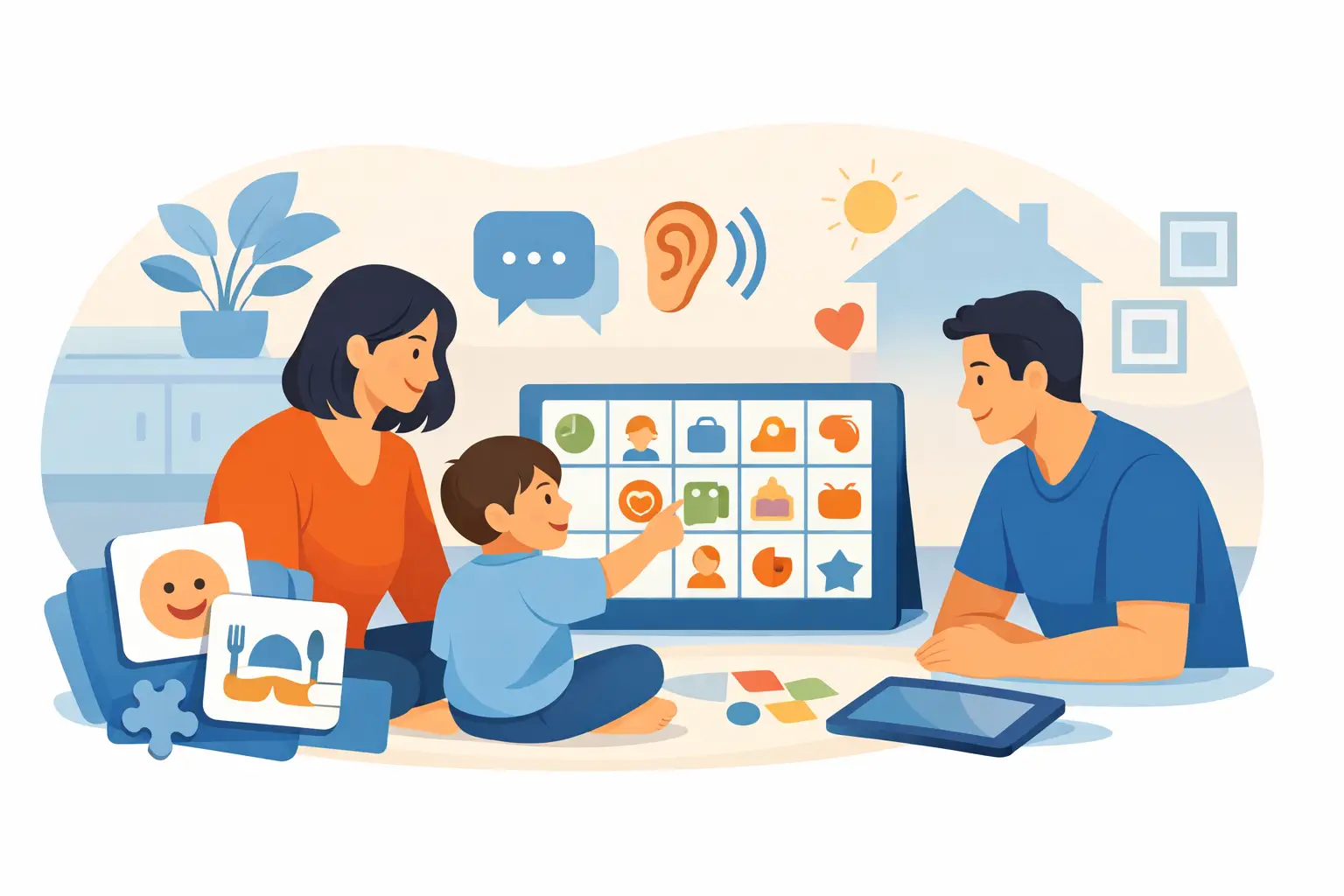
A communication board can change a hard moment in seconds. Your child may be reaching, crying, pulling you toward the pantry, or looking for a way to say “again.” A few meaningful symbols can turn that uncertainty into a message. This parent guide to communication boards explains how to begin with confidence, build the habit naturally, and make AAC part of everyday family life.
Communication support does not need to wait until your child can point perfectly, sit for a long activity, or see a specialist. Many children benefit from having more ways to express what they want, feel, notice, and share. The goal is not to test your child. It is to give them a reliable way to be understood.
What a communication board does
A communication board is a visual collection of words, pictures, or symbols that a child can select to communicate. It may be printed on paper, displayed on a tablet, or used with speech output that says the selected word aloud. It is one form of AAC, short for augmentative and alternative communication.
For some children, a board supports emerging speech. For others, it becomes a primary communication tool. Neither outcome is a failure. AAC gives a child access to language now, rather than asking them to wait until spoken words are easier.
A useful board goes beyond requesting snacks or favourite toys. Requests matter, especially because they create quick, motivating wins. But children also need language for refusing, commenting, asking for help, connecting with people, and sharing how they feel. Words such as “stop,” “more,” “funny,” “help,” “go,” and “all done” can be powerful because they work in many settings.
Parent guide to communication boards: start small
The best first board is not necessarily the biggest one. A board with too many symbols can make it harder for both you and your child to know where to begin. Start with a small set of high-use words connected to your child’s real day.
Think about the moments that bring the most frustration or the most joy. Breakfast, getting dressed, bath time, playground trips, screen time, and bedtime are all useful starting points. Choose words your child has a reason to use often, such as “eat,” “drink,” “open,” “play,” “more,” “help,” “no,” and “finished.” Add a few people, preferred items, or activities that matter to them.
There is a trade-off here. Highly specific words, like the name of a favourite cereal, can create immediate excitement. Core words, such as “want,” “more,” and “go,” offer greater flexibility across the day. Your child needs both over time. Begin with the language that is most likely to help them communicate today, then expand as you see what they reach for and what is missing.
Place the board where communication happens. A board stored in a drawer cannot help during a difficult transition. Keep it nearby at meals, in the living room, in the car, or on a device your child can access easily. If you use a tablet-based board, make sure it is available for communication, not only brought out for practice.
Model the words without pressure
The most effective way to introduce a communication board is to use it yourself. This is called modelling or aided language input. You speak naturally while pointing to, selecting, or activating a word on the board.
If your child reaches for bubbles, you might say, “More bubbles?” while selecting “more.” Before opening a container, pause and model “open.” When the music ends, select “again” or “all done” as you say the words. You are showing your child that the board is a real tool for communication, not an assignment they have to complete.
Keep your language slightly ahead of what your child currently communicates. If they are using single words or symbols, model one- or two-word messages. If they are beginning to combine words, model short combinations such as “want swing” or “go outside.” There is no need to turn every interaction into a lesson.
Wait after modelling. A quiet pause gives your child time to process, look, reach, point, or respond in their own way. Some children need several seconds. Others may communicate through eye gaze, body movement, vocalization, or by bringing you the device. Treat those attempts as meaningful, then show them how the board can add to the message.
Avoid repeatedly asking, “What do you want?” or insisting that your child use the board before receiving something they need. Communication should not become a gatekeeper for food, comfort, or support. Model the word, offer the item, and keep the interaction warm. Confidence grows when a child learns that communication works.
Build communication into ordinary routines
Consistency matters more than long practice sessions. Five useful moments scattered through the day can have more impact than one structured activity when everyone is tired.
At meals, model words for choices, more, finished, drink, and help. During play, use go, stop, turn, again, and funny. In the bath, try in, out, splash, warm, and wash. During transitions, words like wait, first, then, go, and home can make routines more predictable.
Follow your child’s interests rather than forcing a planned topic. If they are fascinated by trucks, that is a strong opportunity for “go,” “big,” “fast,” “again,” and “stop.” If they repeatedly select the same word, respond as though they are telling you something. Repetition is often practice, exploration, enjoyment, or an attempt to connect.
Communication is not limited to calm moments. A board can be especially valuable when your child is overwhelmed, frustrated, or unable to find speech. Keep language simple in those moments. Offer access to words like “break,” “help,” “hurt,” “stop,” “quiet,” and “home,” while also responding to the emotion behind the message.
Customise the board as you learn
A communication board should grow with your child, not stay frozen at the setup stage. Notice which symbols are used, ignored, or missing. You may find that a favourite activity needs to be added, a symbol is too abstract, or a word needs to move to an easier-to-reach location.
Personal photos can be helpful for people, favourite places, and familiar objects. Standard symbols can be easier to recognize across school, therapy, and community settings. Many families use a mix. The right choice depends on what your child understands most easily and what they need to communicate.
Try not to remove a word simply because it has not been selected yet. Your child may need more models before they understand its purpose. At the same time, do not let the board become crowded with rarely useful vocabulary. Review it regularly and make changes based on real use, not guesswork.
Share the same language across home, school, and therapy
Children make faster progress when the adults around them use similar language and respond in similar ways. Send a simple note or screenshot of key words to educators, therapists, grandparents, and other caregivers. Explain how your child currently accesses the board, whether by touch, pointing, eye gaze, or partner support.
It also helps to share what is working. Perhaps your child uses “again” consistently during play, selects “help” when a container is closed, or communicates most during snack time. These details give an SLP or school team a clearer picture than a general update that AAC is “going well.”
A connected platform such as VoiceBloom can make that collaboration easier by bringing communication tools, usage patterns, parent coaching, and progress reporting into one place. That visibility can help adults adjust goals together and carry successful strategies between home, therapy, and school.
Know what progress can look like
Progress is not only measured by the number of words your child says aloud. It may look like looking toward the board when they need something, accepting your model, making a choice, using a symbol independently, combining two words, or using AAC with a new person.
Some days will feel quiet. That does not mean the board is not working. Learning a new communication system takes time, access, modelling, and trust. If your child seems to avoid the board, look at the setup before assuming they are not ready. Is it within reach? Are the words meaningful? Are adults modelling it often enough? Is the layout too busy or difficult to access?
If you have concerns about language development, motor access, vision, hearing, or the right vocabulary, an SLP and your child’s care team can offer valuable guidance. Parents do not need to have all the answers before starting. Your daily observations are part of the expertise that shapes a better communication system.
Your child has things worth saying right now - preferences, jokes, protests, questions, ideas, and connections. Keep the board close, model without pressure, and celebrate every attempt to be understood. A voice grows through thousands of small, shared moments.