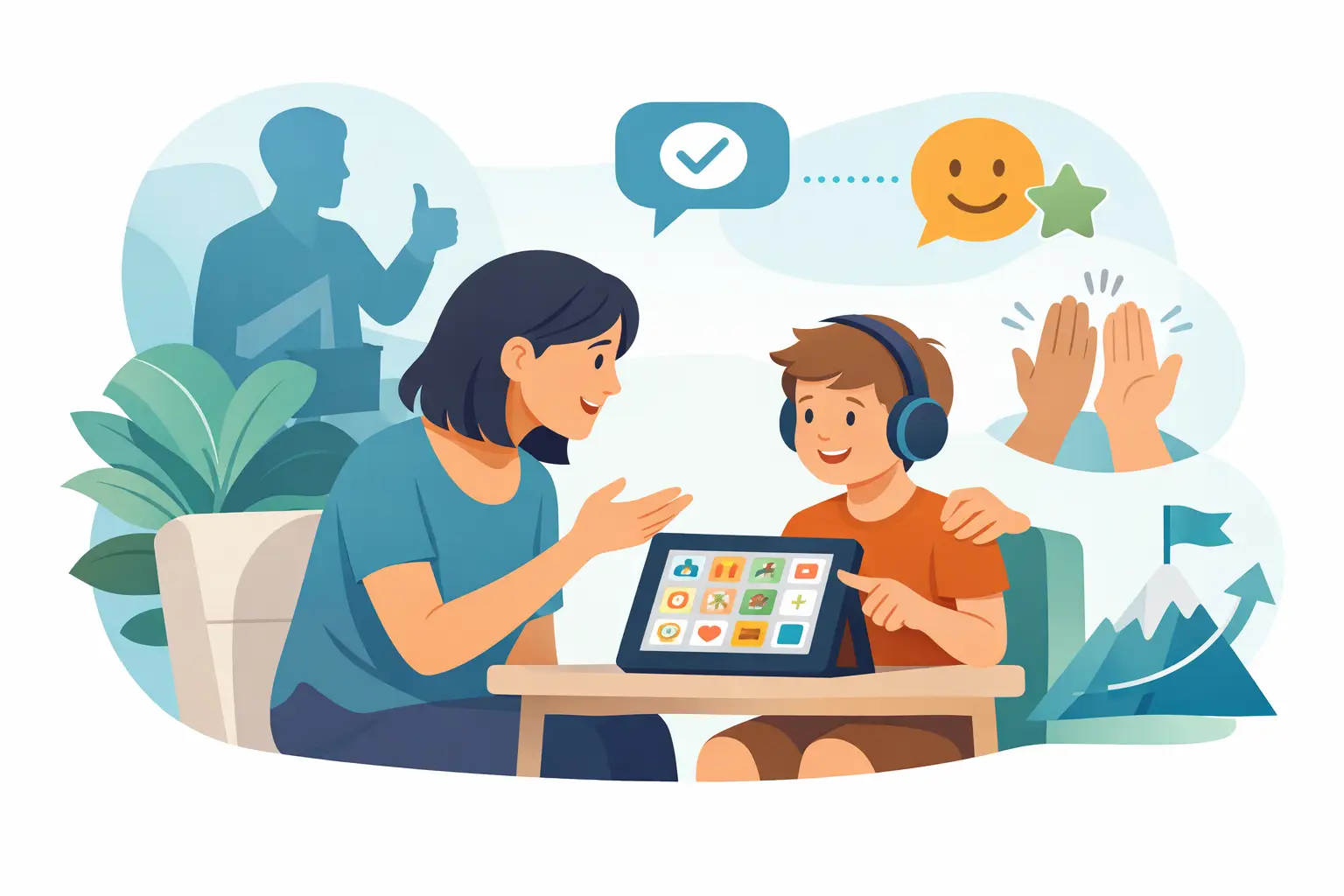
The hardest part of AAC is rarely finding a button for a word. It is knowing what to do when your child looks away, presses the same symbol repeatedly, or seems unsure where to begin. Parent guided AAC coaching gives families practical support for those ordinary moments, so communication does not have to wait for the next therapy appointment.
What parent guided AAC coaching really means
Parent guided AAC coaching is a structured way to help caregivers support a child’s communication system at home, in the community, and during everyday routines. Rather than handing a family an AAC board or device and hoping it becomes part of daily life, coaching offers clear next steps based on the child’s real use.
The goal is not to turn parents into speech-language pathologists. Parents already know their child’s favourite snacks, silly jokes, difficult transitions, and most motivating activities. Coaching helps them use that knowledge with AAC in ways that feel manageable and responsive.
For many families, the most useful guidance is surprisingly small: model one or two words during breakfast, keep the board within reach during play, pause long enough for a child to respond, or acknowledge every meaningful attempt to communicate. Those actions can create more opportunities than a long, pressured practice session.
Why a communication system needs guidance at home
AAC works best when it is available where life happens. A child may use a device successfully with a therapist, then leave it in a backpack through dinner, bath time, errands, and play. That is not a failure by the child or parent. It is often a sign that the adults around the child need a clearer plan for making AAC useful in more settings.
Home use also gives children a reason to communicate beyond answering questions. They can protest when a game ends, ask for a different song, comment on something funny, or tell someone they are finished. These messages matter because communication is not only about requesting. It is about having influence, connection, and a way to be understood.
Parent coaching makes the work less dependent on perfect conditions. You do not need a quiet therapy room, a planned lesson, or an hour of uninterrupted time. You need access to the AAC system and a few repeatable habits that fit your family.
Start with modelling, not testing
One common concern is that a child will not use AAC independently right away. It is understandable to want proof that the system is helping. But repeatedly asking, “What do you want?” or “Show me more,” can make communication feel like a test.
A stronger starting point is aided language modelling. This means you speak naturally while also selecting relevant words on the child’s AAC board or device. If you are pouring juice, you might say, “More juice,” while choosing “more.” If the bubbles pop, you could model “again” or “fun.” The child does not need to copy you for the moment to count.
Modelling shows a child where words live and how AAC can carry meaning. It also takes pressure off. Children learn spoken language by hearing it used around them for years. AAC deserves the same patient exposure.
Keep the language slightly simpler than what you say aloud. You may speak a full sentence while modelling one key word. Over time, you can add combinations such as “want swing,” “go outside,” or “not that.” The right level depends on the child, their motor access, visual needs, and familiarity with the system.
Build coaching into routines you already have
The most sustainable plan is the one your family can repeat. Instead of setting aside a formal AAC block every day, choose routines with natural reasons to communicate. Snack time, getting dressed, car rides, screen time, outdoor play, and bedtime all offer useful opportunities.
At snack time, model choices, “more,” “different,” “all done,” and comments such as “yummy” or “cold.” During play, use words that keep the activity moving: “go,” “stop,” “help,” “again,” “my turn,” and “big.” At bedtime, the focus may be calmer: “book,” “cuddle,” “tired,” “scared,” or “music.”
The point is not to force a target word into every interaction. Follow your child’s interest. If they are fascinated by a spinning toy, that interest is an opening for shared attention and communication. When AAC is connected to what the child genuinely cares about, it is more likely to become useful.
Use data to replace guesswork
Coaching becomes more effective when families and professionals can see what is actually happening. Is AAC being used mostly for requests? Which words appear often? Does use increase during play but drop during transitions? Are there times of day when the device is not available?
Usage data cannot tell the whole story. A child may communicate through eye gaze, gesture, facial expression, behaviour, or speech attempts that a screen does not capture. Still, clear data can reveal patterns that memory misses. It can help adults decide whether to add vocabulary, adjust the layout, practise access skills, or focus on a particular routine.
This is where a connected platform can make a meaningful difference. VoiceBloom brings AAC use, progress tracking, parent coaching, and professional visibility together, helping families start without guessing while giving therapists and educators a clearer view of carry-over between sessions.
The best reports do not reduce a child to a number. They turn patterns into useful questions: What supported communication this week? What got in the way? What is one realistic next step for home and school?
Keep goals small enough to use
A broad goal like “use AAC more” can feel encouraging but does not tell a caregiver what to do on Tuesday morning. A coaching goal should be specific, relevant, and light enough to carry into real life.
For example, a family may decide to model “help” during one daily dressing routine for a week. Another may keep the AAC system on the table during dinner and model two comments without asking the child to respond. A school team might focus on making sure the same core words are available during recess and classroom activities.
Small goals are not small outcomes. They build consistency, and consistency gives children more chances to learn that AAC is always there for them. If a goal is not working, change it. A plan that creates stress is not automatically better because it looks ambitious on paper.
What to do when progress feels slow
Some children explore AAC immediately. Others need time to tolerate the device, understand the symbols, build motor patterns, or trust that adults will honour their messages. Progress may look uneven, especially when a child is tired, sick, overwhelmed, or adjusting to a new setting.
When communication seems stalled, check the basics first. Is the system available and charged? Is it positioned so the child can access it comfortably? Are adults modelling without demanding performance? Does the vocabulary include words that matter to the child, not only words adults want them to say?
Also consider whether the child needs additional support from an SLP, occupational therapist, teacher, or other care provider. AAC coaching is powerful, but it is not a replacement for clinical assessment when access, language, hearing, vision, or motor needs require deeper expertise. The strongest support often comes from adults working from the same information rather than in separate silos.
Create consistency without making everyone identical
Parents, grandparents, educational assistants, teachers, and therapists will not all interact in exactly the same way. That is normal. What matters is shared direction: the AAC system is available, the child’s messages are respected, adults model language, and key goals travel across settings.
A brief weekly check-in can help. Look at what your child used, which routines went well, and where support broke down. Then choose one next step. This approach is more useful than trying to overhaul vocabulary, routines, and expectations all at once.
Parent guided AAC coaching is not about getting every interaction right. It is about giving your child repeated proof that their ideas, refusals, questions, and jokes have a place to go. Start with one routine, one meaningful word, and one patient pause. Those moments can grow into a communication system your child can rely on wherever life takes them.