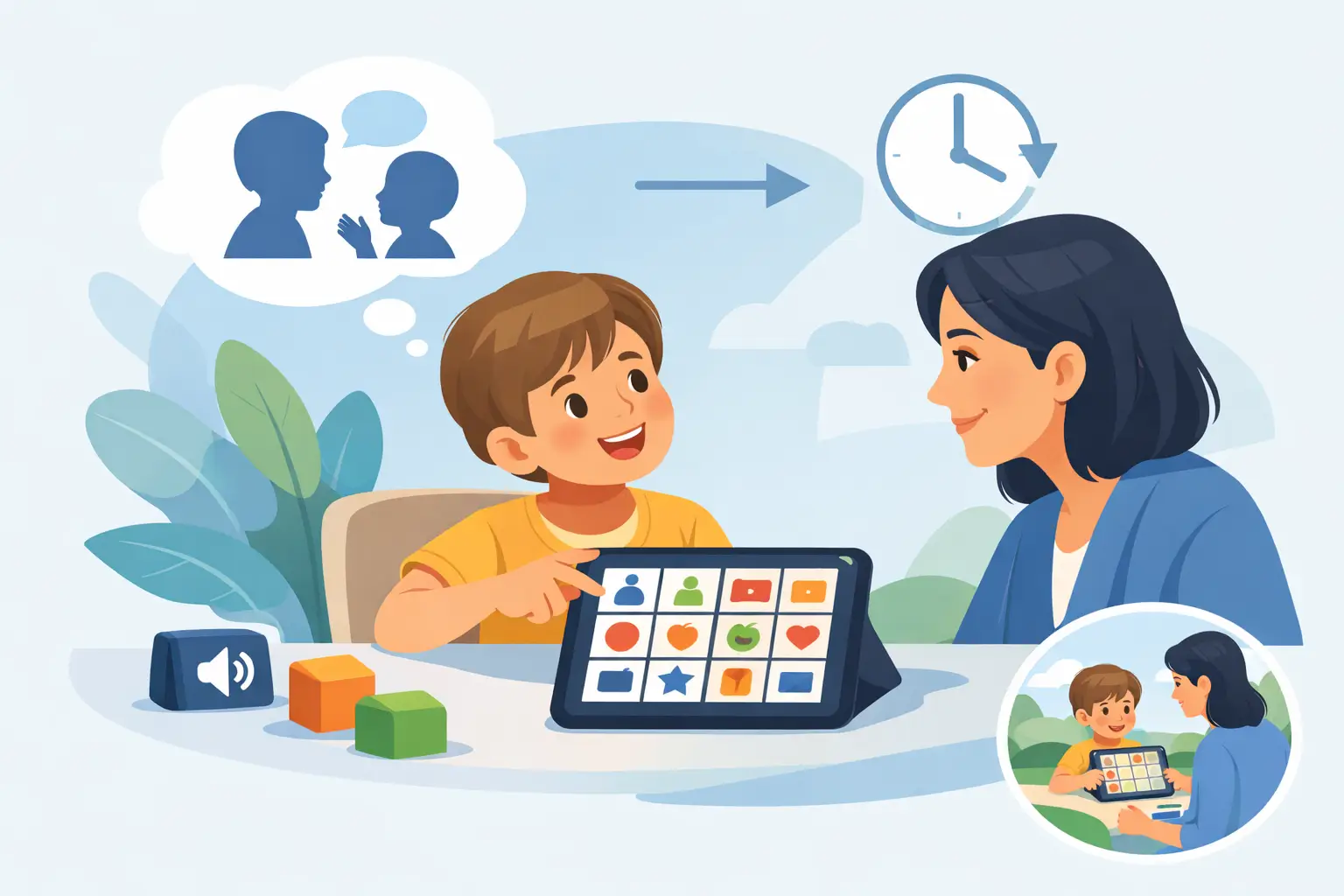
A child who cannot reliably tell you they are thirsty, finished, worried, excited, or in pain is not waiting for the right age to communicate. They are communicating already, through looks, movement, sounds, behaviour, and the people who know them best. So, when should a child start AAC? For most children with significant speech or language challenges, the answer is: as soon as communication support could make life easier.
AAC, or augmentative and alternative communication, does not replace a child’s voice or reduce the value of speech therapy. It gives them another way to share what they mean while spoken language is emerging, inconsistent, difficult to understand, or not available. That can mean a simple picture board, gestures and signs, a communication app with speech output, or a combination of tools.
When should a child start AAC?
There is no minimum age, no magic number of words, and no need to wait for a child to “fail” at speech before offering AAC. Children can begin using visual communication supports in toddlerhood, and some benefit even earlier through adult modelling and predictable routines.
The more useful question is not, “Are they ready for AAC?” It is, “Are we ready to give them more ways to communicate?”
If a child is regularly frustrated because others cannot understand them, AAC may help now. If they rely on pulling an adult’s hand, crying, guessing games, or repeated prompts to get needs met, AAC may help now. If they have words but cannot access them consistently when tired, overwhelmed, excited, or outside the home, AAC may help now.
Early access matters because communication is more than requesting snacks or favourite toys. Children need ways to protest, ask questions, make choices, join play, comment on what they see, and tell people when something hurts. Waiting limits opportunities to practise these powerful, everyday interactions.
AAC does not require “readiness” tests
Many families have heard outdated advice: wait until your child can sit still, point accurately, understand cause and effect, recognize pictures, or show more interest in people. These skills can make some systems easier to use, but they are not entry requirements for communication.
AAC is a support, not a reward for demonstrating enough skills. A child can learn to use it through regular exposure, just as children learn spoken words by hearing language used around them. Adults model words on the system while talking naturally, without demanding that the child copy every selection.
For example, at snack time, a caregiver might say, “You want more,” while selecting MORE. During a difficult transition, they may model “no,” “help,” or “all done.” At the park, they can add “go,” “fun,” “fast,” or “again.” The goal is not perfect performance. The goal is showing the child that their thoughts can be seen, heard, and responded to.
Some children will begin with a few meaningful selections. Others may explore buttons, repeat sounds, or watch adults use the board before trying it themselves. That exploration is part of learning, not a reason to take AAC away.
Speech can still grow alongside AAC
A common fear is that AAC will discourage a child from talking. Research and clinical experience consistently show that AAC does not stop speech development. For many children, reducing the pressure and frustration around communication can support more language growth, including speech where speech is possible.
Think of AAC as a bridge. A child may use a symbol, gesture, spoken approximation, or all three together. If they can say “ba” while selecting BATHROOM, the message still counts. The priority is successful communication, not choosing one “correct” method.
Signs your child may benefit from AAC now
AAC can support children with autism, cerebral palsy, childhood apraxia of speech, Down syndrome, developmental language differences, genetic conditions, brain injury, and other communication needs. A formal diagnosis is not required to start offering supportive communication tools.
Consider adding AAC if your child has difficulty expressing wants, needs, feelings, or ideas in ways unfamiliar listeners understand. It can also help when speech is limited, unclear, unreliable, or much harder than the child’s understanding of language.
Pay attention to the hard moments. Does your child become upset when you cannot guess what they want? Do they have more to say than they can get out? Do they communicate well in one setting but struggle at daycare, school, appointments, or with extended family? These are not signs that they need to try harder. They are signs that the communication environment needs to offer more support.
AAC is also valuable for children who use some speech. A child may speak in familiar routines but need visual or speech-output support during transitions, when advocating for themselves, or when building longer messages. Communication needs can change across settings and over time.
Start small, but start with real language
Beginning AAC does not mean creating a giant program overnight. Start with access to a consistent system and a handful of words that matter across daily life. Avoid limiting the board to nouns such as cookie, car, and bubbles. Those words are useful, but children also need flexible words that let them direct the interaction: MORE, STOP, GO, HELP, WANT, NOT, LIKE, and ALL DONE.
Keep the system available, not stored away for “practice time.” Communication happens in the car, at breakfast, in the bath, during play, and in the middle of a tough moment. If the device or board only appears when an adult asks, “What do you want?” the child may learn that AAC is a test rather than their voice.
Model more than you expect. You do not need to select every word you say, and you do not need to make every interaction a lesson. Choose one or two key words, speak naturally, and respond warmly to any attempt to communicate.
Consistency matters, but perfection does not. Families are busy, children have variable days, and school routines can be demanding. A practical AAC plan is one that fits real life. Even a few intentional models each day can build familiarity when everyone uses the same approach.
Build a team around the child’s communication
Parents should not have to wait months for a perfect plan before giving their child a way to communicate. At the same time, collaboration with a speech-language pathologist, educator, occupational therapist, or other care team can help tailor access, vocabulary, positioning, and goals.
The best support connects home, therapy, and school. When one adult models HELP and another uses a different layout or different expectations, the child has to work harder. Shared vocabulary and visible progress make it easier for everyone to reinforce communication in the moments that matter.
Look for patterns, not just totals. Which words does the child use independently? What happens before communication breakdowns? Are they communicating more at home than school? Are they moving beyond requests into comments, refusals, social connection, and self-advocacy? These observations help adults make better decisions without guessing.
A connected platform such as VoiceBloom can make that coordination simpler by helping families start quickly while giving therapists and educators meaningful usage information to guide next steps.
What to do if you are unsure
You do not need to decide that AAC will be your child’s communication method forever. You are deciding to give them access to another option today. Start with a trial period, observe how your child responds, and adjust with support from professionals when available.
Choose a system that can grow with your child rather than one built only for requesting. Make sure it is easy for the adults in their life to learn, available in the settings where communication breaks down, and flexible enough to reflect the child’s interests and personality.
Most of all, do not wait for certainty. Children do not need to earn a voice. Give them words, model them with patience, and let every successful message show them that what they have to say matters.